Trading Psychology Tools: What They Are and Why Traders Need Them
Most traders don't blow up their accounts because they picked the wrong indicator. They blow up because they held a losing position too long, doubled down after a bad session, or abandoned a working strategy after three red days in a row.
The problem isn't the strategy. It's the trader executing it.
That's exactly what trading psychology tools are built to address. They help you see the emotional and behavioral patterns in your own trading data — patterns that are almost impossible to notice in the moment, but very visible in the data after the fact.
This article breaks down what these tools actually do, which psychological biases they help you catch, and what to look for when choosing one.
What Are Trading Psychology Tools?
Trading psychology tools are software features or platforms that analyze your trading behavior — not just your results.
Where a standard performance report tells you your win rate or average R-multiple, a psychology tool asks a different question: why did you take that trade, and what happened to your behavior before, during, and after it?
These tools typically work by cross-referencing your trade data against behavioral patterns: position sizing over time, trade frequency after wins and losses, average hold time on losing trades versus winners, and the gap between planned and actual execution. Some also analyze journal notes and mood tags using language processing, correlating what you wrote with how the trade turned out.
The goal isn't to replace discipline with software. It's to give you the kind of objective feedback that's nearly impossible to generate on your own.
Why Traders Struggle Without Them
Here's the core problem: biases don't feel like biases. They feel like reasonable decisions.
When you add to a losing position, it feels like conviction. When you cut a winner early, it feels like prudence. When you overtrade after a bad day, it feels like recouping losses — not revenge trading.
Without data, you're relying on memory and self-perception — both of which are notoriously unreliable when money is involved. A behavioral trading analysis looks at what actually happened across hundreds of trades, not what you remember about any single one. That's where the real patterns emerge.
The Core Psychological Biases Trading Tools Help Detect
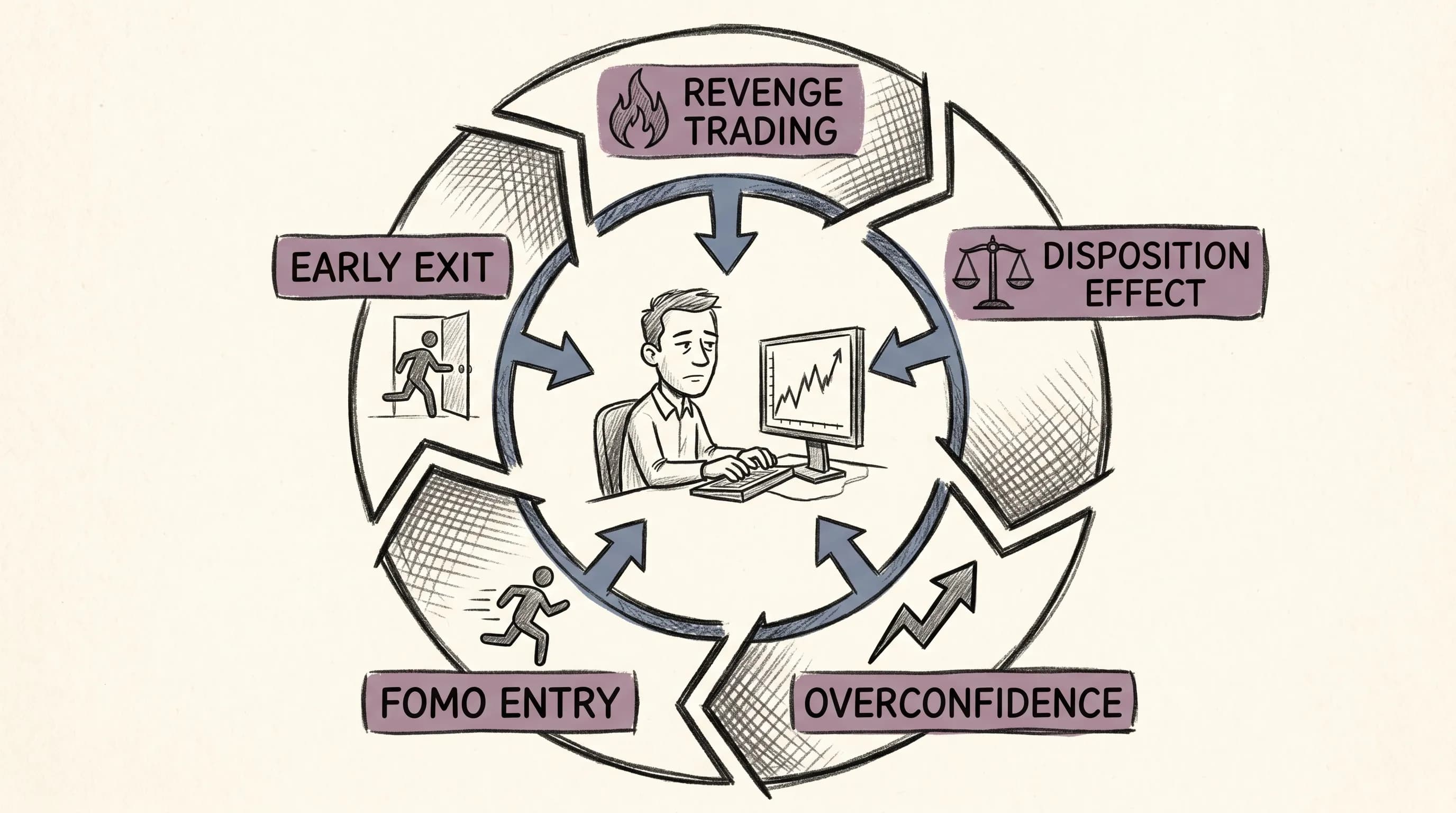
Understanding what these tools are looking for makes them significantly more useful. The most common patterns they surface:
Revenge trading — taking more trades, or larger trades, immediately after a loss. The data signature is clear: spike in frequency or position size within a defined window after a drawdown. Left unchecked, this turns a manageable losing day into a significant account drawdown.
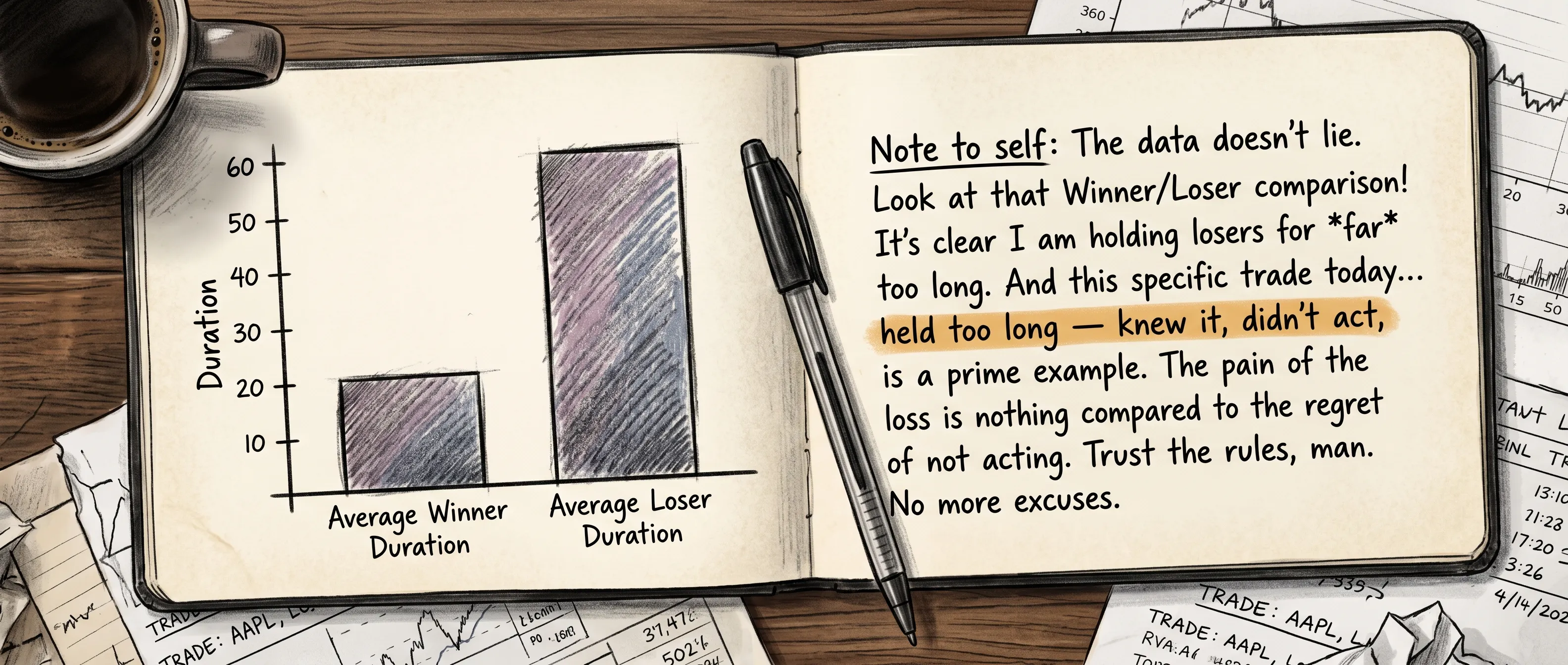
Disposition effect — holding losing trades longer than winning ones. Most traders intuitively know this is a problem, but seeing it quantified in your own data — "your average losing trade duration is 3.2x your average winner" — is a different kind of confrontation.
Overconfidence after wins — increased risk-taking following a profitable streak. This shows up as higher position sizes or more frequent entries in the sessions or days after a strong run.
FOMO entries — taking trades that don't match your setup criteria during high-volatility moves. These trades are often identifiable by their entry timing relative to a sharp price move in the market.
Early exits on winners — fear-driven closing of positions before the target is reached. Over a large sample, this dramatically compresses your actual R-multiple versus your planned one.
Each of these has a measurable footprint in your trade data. A good psychology tool finds it.
What to Look for in a Trading Psychology Tool
Not every platform that calls itself a behavioral analysis tool actually delivers depth. Here's what matters:
Pattern detection across your full trade history, not just recent trades. Behavioral biases are long-run tendencies. A tool that only shows you last week's data misses the point.
Correlation between your logged state and your outcomes. If you're tagging mood, energy, or market conditions in your journal, the tool should be able to connect those tags to actual performance. "How does my performance differ when I'm journaling as anxious vs. confident?" is a real and answerable question — but only if the tool is built to surface it.
Quantified metrics, not vague observations. Feedback like "you may be holding losers too long" is less useful than "your average loser is held 4.1x longer than your average winner, and your worst drawdowns correlate with days when you had 3+ consecutive losses." Specificity is what drives change.
Integration with your actual trade data. Tools that require manual data entry introduce friction and inconsistency. The best implementations connect to your broker directly, so the behavioral data reflects every trade — not just the ones you remembered to log.
How a Trading Journal Makes Psychology Tools More Powerful
The journal is the foundation. Every note you write, every mood tag, every trade rationale — that becomes behavioral data that the tool can analyze.
A strong trading performance tracker doesn't just log numbers. It captures the context around them. When you add a note that says "entered late, felt like I was missing the move," that's a data point. When that pattern appears 40 times across 200 trades, and correlates with below-average outcomes, it's an insight.
This is why platforms that combine journaling with analytics tend to outperform either function in isolation. The journal gives language to the trade. The analytics give scale and objectivity to the pattern.
The Role of Backtesting in Understanding Your Psychology
One underused application of backtesting is isolating psychological execution problems.
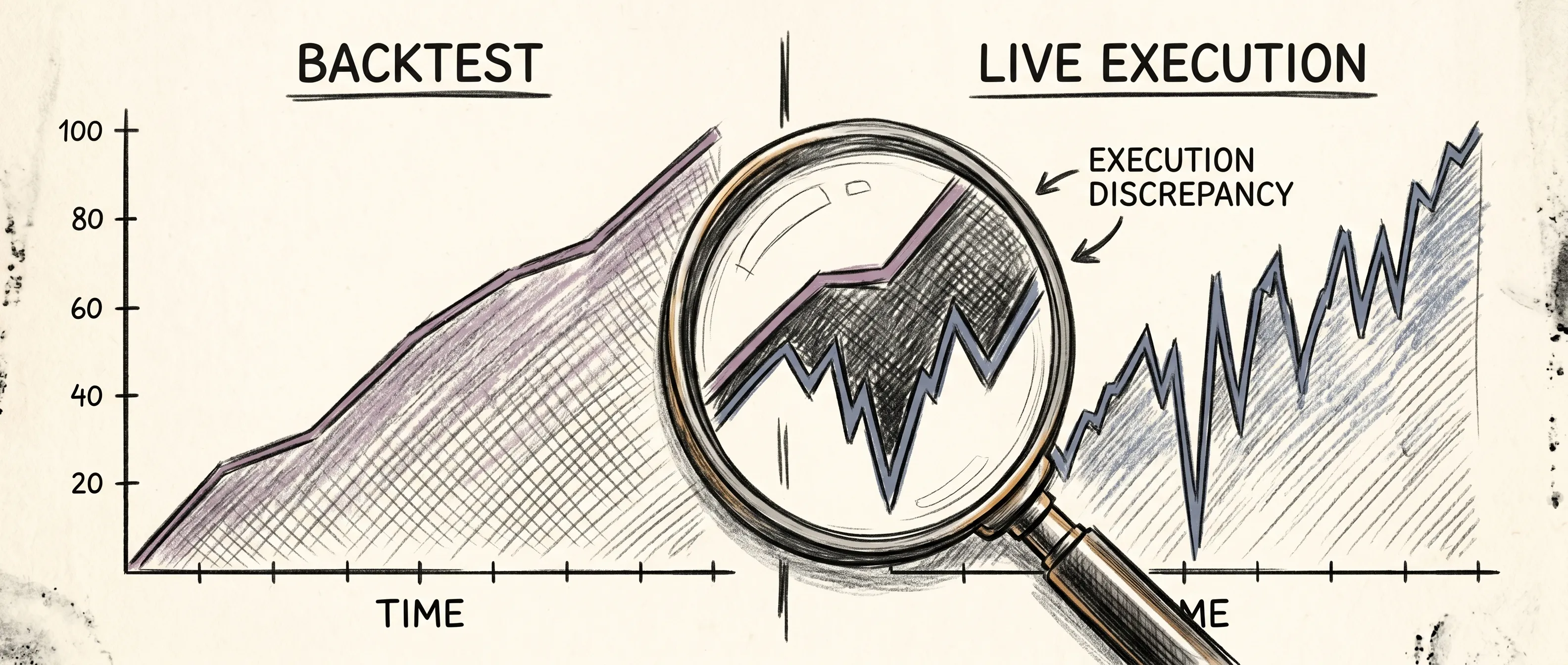
If your strategy backtests well but underperforms live, the gap is almost always behavioral. You can see this by comparing the theoretical backtest results against your actual live execution on the same setup. When those diverge — same setup, different outcomes — the variable is you: early entries, premature exits, skipped trades during drawdowns.
Understanding how to backtest a trading strategy isn't just about validating an edge. It's also about creating a baseline that makes your real behavioral patterns visible.
Putting It Together
The traders who improve consistently over time aren't the ones with the best entry signals. They're the ones who can look at their own behavior honestly, identify where their psychology is costing them, and make measurable changes.
That's a data problem as much as a discipline problem. And it's exactly what the right tools are designed to solve.
ChartWise's behavioral analytics surfaces these patterns automatically — from revenge trading detection to hold time analysis to correlation between your logged emotional state and your outcomes. If you're serious about understanding what's actually driving your results, join the waitlist and get early access.
FAQ:
What are trading psychology tools?
Trading psychology tools are software features that analyze your behavioral patterns in trading — such as how you size positions after losses, how long you hold losers versus winners, and whether your entries align with your stated strategy. They help you identify emotional biases using your actual trade data.
Why is trading psychology important for traders?
Most underperformance in trading isn't caused by a bad strategy — it's caused by inconsistent execution driven by emotions like fear, greed, or frustration. Understanding your psychological tendencies through data gives you the ability to correct them systematically rather than relying on willpower alone.
What psychological biases affect traders most?
The most common ones are revenge trading, the disposition effect, overconfidence after winning streaks, FOMO-driven entries, and cutting winners too early. All of these have measurable patterns in trade data and can be identified with the right analytics tools.
How does a trading journal help with psychology?
A trading journal captures the context behind every trade — your reasoning, emotional state, and post-trade notes. When combined with behavioral analytics, that qualitative data becomes quantifiable: you can see whether your performance differs based on emotional state, session type, or market condition.
What should I look for in a trading psychology tool?
Look for tools that analyze your full trade history (not just recent data), correlate journal notes with performance, surface specific quantified metrics rather than vague observations, and connect directly to your broker for accurate data without manual entry.