If you're a swing trader, you already know the feedback loop is slow.
A day trader can blow up, rebuild, and reach clarity inside a single session. You don't have that option. You enter a trade on Monday. You're still holding it Thursday. You exit Friday at a small loss — or a decent gain — and two weeks later you can't quite remember what your original thesis was. Whether you held it honestly. Whether the exit was disciplined or driven by impatience.
That's the problem a swing trading journal solves. Not "writing things down." That's the surface. The real problem is that without structured documentation, your edge — whatever it is — stays invisible to you. You repeat the same exit mistakes for five consecutive months and chalk it up to bad luck. The journal is what turns a pattern you can't see into one you can act on.
This guide covers how to build and use one that actually generates feedback.
Why Swing Trading Demands a Different Journal
The most common mistake is applying a day trader's template to swing trades. They're built for a completely different problem.
A day trading journal is built around speed — volume, entries, exits, rapid feedback loops that close within hours. A swing trading journal is built around thesis — the reasoning behind a position that might take two weeks to fully resolve.
Day traders might log 20 trades before lunch. Swing traders might log 10 to 15 trades in a month. That lower volume means two things: every trade carries significantly more analytical weight, and the feedback is genuinely slow. Without documentation, three months can pass before you notice you've been repeating the same behavioral mistake — cutting winners on trend days, holding losers through key invalidation points, entering before confirmation because the setup "looked close enough."
A swing trading journal is your only reliable defense against that kind of invisible repetition.
What to Log in Every Swing Trade
Logging "bought at X, sold at Y" gives you a record. It doesn't give you feedback. For swing trades that play out over days or weeks, the decision layer is where the information lives.
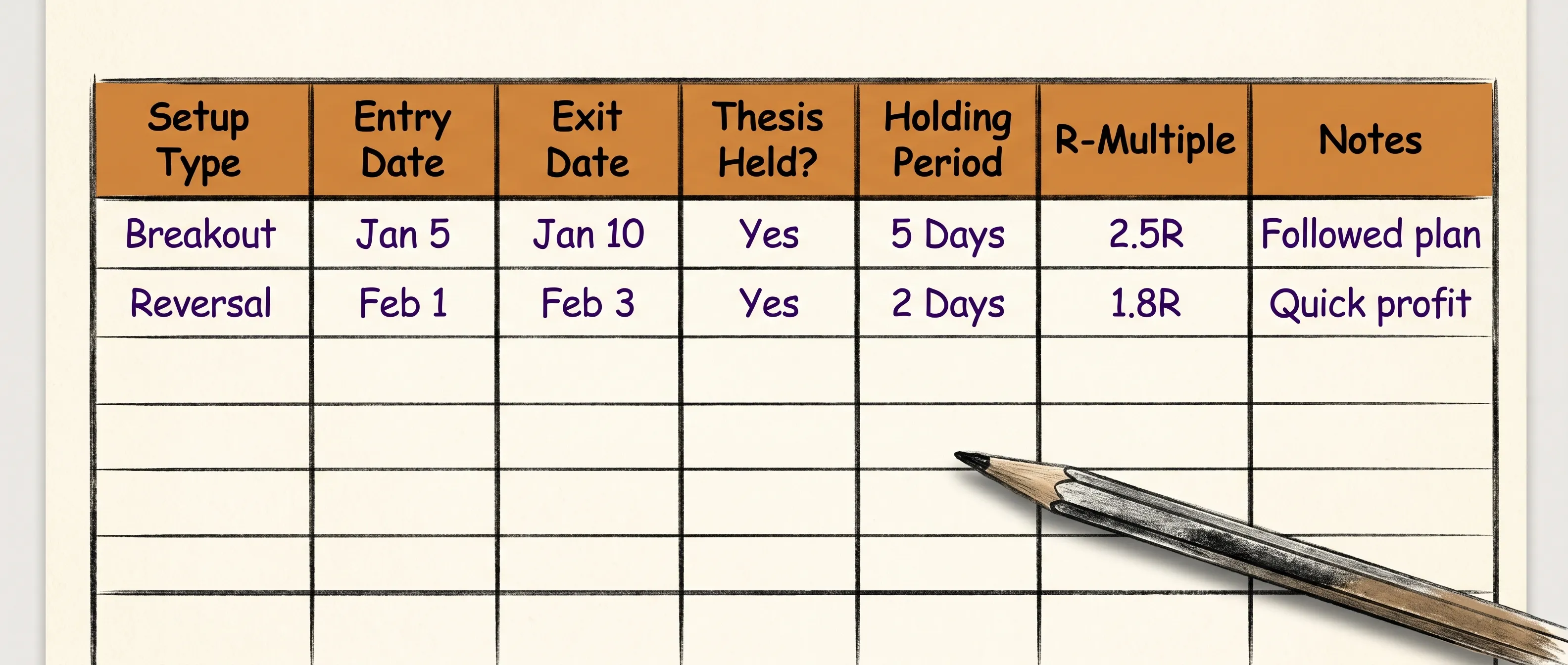
Here's what every swing trade entry needs:
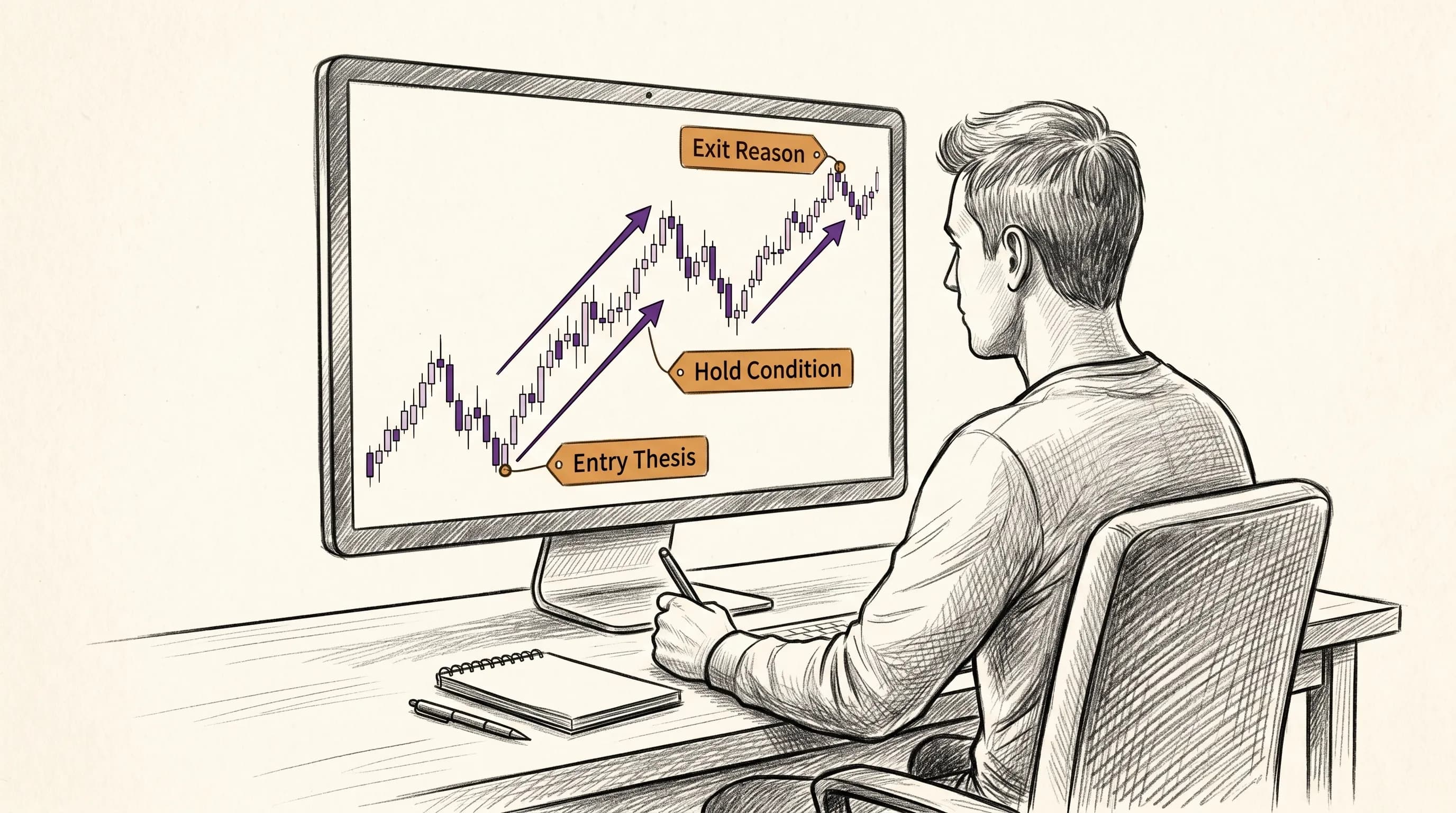
Entry thesis. Not just the setup name — the reasoning. "Breakout above multi-week resistance with expanding volume on the daily chart. Trend structure is intact. Risk defined below the breakout level" is a thesis. "Looked strong" is not. You need something specific enough that you can check it against reality two weeks later.
Hold conditions. What would change your mind and cause an early exit? What must remain true for the position to stay open? This is the most skipped field in swing journaling, and it causes the most damage. "Held because the thesis was still valid" only means something if you wrote the thesis down and defined what would invalidate it.
Exit reason. Was the exit planned — target hit, stop triggered, thesis invalidated — or was it reactive — anxiety, news, boredom, wanting to lock in something before a weekend? Your trade review process depends on knowing which exits were disciplined and which were improvised. A reactive exit that happened to work is still a bad process.
Emotional state at entry and exit. Rushed. Overconfident. Anxious. FOMO-driven. These feel like soft fields until you aggregate 40 trades and notice that your worst exits cluster around states you logged as "impatient." Log it every time.
Holding period. The exact number of days. This becomes meaningful later when you run performance breakdowns by hold length.
Key Metrics That Matter for Swing Traders
Standard metrics tell part of the story. These are the swing-specific ones that complete it.
R-multiple by setup type. Don't average R-multiples across all trades. Break them down by setup category. You might find your trend continuation plays average +1.8R while your mean-reversion entries average –0.3R over the same period. That's an actionable edge discovery. Your trading performance tracker should be able to surface this breakdown without manual calculation.
MFE and MAE. Maximum Favorable Excursion tells you how far a trade moved in your favor before you exited. Maximum Adverse Excursion tells you how far against you a trade went before it recovered. Together, these two fields are the most revealing in a swing journal. If your MFE consistently runs 3R before you exit at 1R, you're leaving systematic edge on the table. If your MAE on winning trades regularly dips 1.5R before recovering, your stop placement is either too tight or you're entering too early.
Win rate by market condition. Trending environment, range-bound, high volatility, post-earnings drift. Swing traders are often highly condition-dependent. A setup that produces consistent edge in trending conditions can be genuinely negative in choppy markets. You'll never see that without tagging market condition on every entry.
Average holding period by outcome. Do your winners close quickly while your losers drag on for weeks? That behavioral fingerprint — cutting winners fast and holding losers long — is the most common destructive pattern in swing trading. The data makes it visible when you track it.
The Weekly Review: Where Improvement Actually Happens
Your journal is useless if you only write in it and never read it. The review is where the learning occurs — not the logging.
Block 20 to 30 minutes every week. The questions to work through:
Did you follow your entry rules this week, or deviate? Where, and why? For trades still open: is the thesis you documented at entry still intact? For closed trades: was the exit reason the one you defined at entry, or did you improvise?
Are any behavioral patterns emerging — particular market conditions, times of week, emotional states — that correlate with your weakest exits?
Your behavioral trading analysis should be pattern-based, not results-based. A losing trade executed with full discipline is valuable information. A winning trade taken on impulse is a liability you got away with. The review helps you tell the difference consistently.
Mistakes That Kill Most Swing Journals
Not logging thesis changes mid-hold. You enter with one reason and halfway through the hold you quietly shift to a different reason to stay in. If that rationalization doesn't get documented, you can't audit the decision later. You'll just remember "the thesis held" when it actually didn't.
Skipping emotional fields. Many traders feel awkward logging their psychological state, as if it belongs in a diary rather than a performance system. It doesn't. Your trading psychology tools can only surface emotion-outcome correlations if you've actually captured the emotion data. Log it every trade.
Treating the journal like a ledger. The point isn't to have a record — it's to create a feedback loop your brain can't generate on its own. If you're filling in fields and never reviewing them, you have a record. You don't have a journal.
Inconsistent setup taxonomy. If you use five different names for the same setup type across 30 trades, you'll never be able to aggregate performance by setup. Pick your labels and use them consistently from the first entry.

How AI Changes Swing Trade Journaling
The fundamental challenge with swing data is volume. You accumulate trades slowly enough that spotting meaningful patterns manually takes months — and by the time you have statistical significance, you've already taken the losses those patterns would have warned you about.
An AI trading journal changes that timeline significantly. AI can analyze three months of swing trades — cross-referencing thesis quality, hold behavior, exit reasoning, and outcome — in seconds. It surfaces correlations that would take a manual reviewer hours to find, if they found them at all.
For swing traders specifically, the most valuable AI function is contextual pattern recognition: not just what happened in a trade, but what sequence of decisions led there. Which entries followed a losing streak? Which setups tended to get exited before target? Which hold conditions were most frequently abandoned?
ChartWise does this through four AI voices — Coach, Mentor, Analyst, and Professional — each approaching your trading data from a different angle. Instead of staring at a spreadsheet trying to reverse-engineer your own patterns, you can ask direct questions: "What's happening with my losing trades held longer than seven days?" and receive a data-grounded answer immediately.
ChartWise for Swing Traders
Swing traders need a journal built for multi-day trade lifecycles — not one designed for high-volume, intraday workflows. ChartWise auto-imports trades and organizes them by setup, holding period, and session context. Performance breakdowns are filtered by the variables that actually matter for swing-specific analysis.
The AI chat surface means the data works for you rather than requiring you to manually interrogate it. You stop journaling. You start asking.
If you also trade equities or derivatives alongside your swing strategies, ChartWise adapts — see how the platform handles stock trading specifically for equities-focused context.
Join the waitlist at chartwise.app.
FAQ
What is a swing trading journal?
A swing trading journal is a structured log of multi-day trades that captures not just entries and exits, but the thesis, hold conditions, exit reasoning, and emotional state behind each decision. Its primary function is to create a feedback loop across a slow enough timeline that patterns would otherwise be invisible.
What should I include in every swing trade log?
At minimum: entry thesis, hold conditions, exit reason, emotional state at entry and exit, setup type, holding period, R-multiple, MFE, and MAE. The fields most traders skip — thesis, hold conditions, emotional state — are consistently the most revealing ones.
How often should swing traders review their journal?
Weekly at minimum. Review open positions against your documented thesis once mid-week. Review all closed trades at week's end. Monthly, run a deeper breakdown by setup type and market condition.
Is a spreadsheet good enough for swing trade journaling?
A spreadsheet handles data entry. It won't analyze behavioral patterns, surface holding-period correlations, or ask you questions about your own decision sequences. For traders who want actionable feedback — not just records — purpose-built software with AI capability is substantially more effective.
How is a swing trading journal different from a day trading journal?
A day trading journal is optimized for volume and rapid intraday feedback. A swing trading journal is optimized for thesis quality, hold discipline, and multi-day behavioral pattern detection. The fields, review cadence, and key metrics are structurally different between the two.