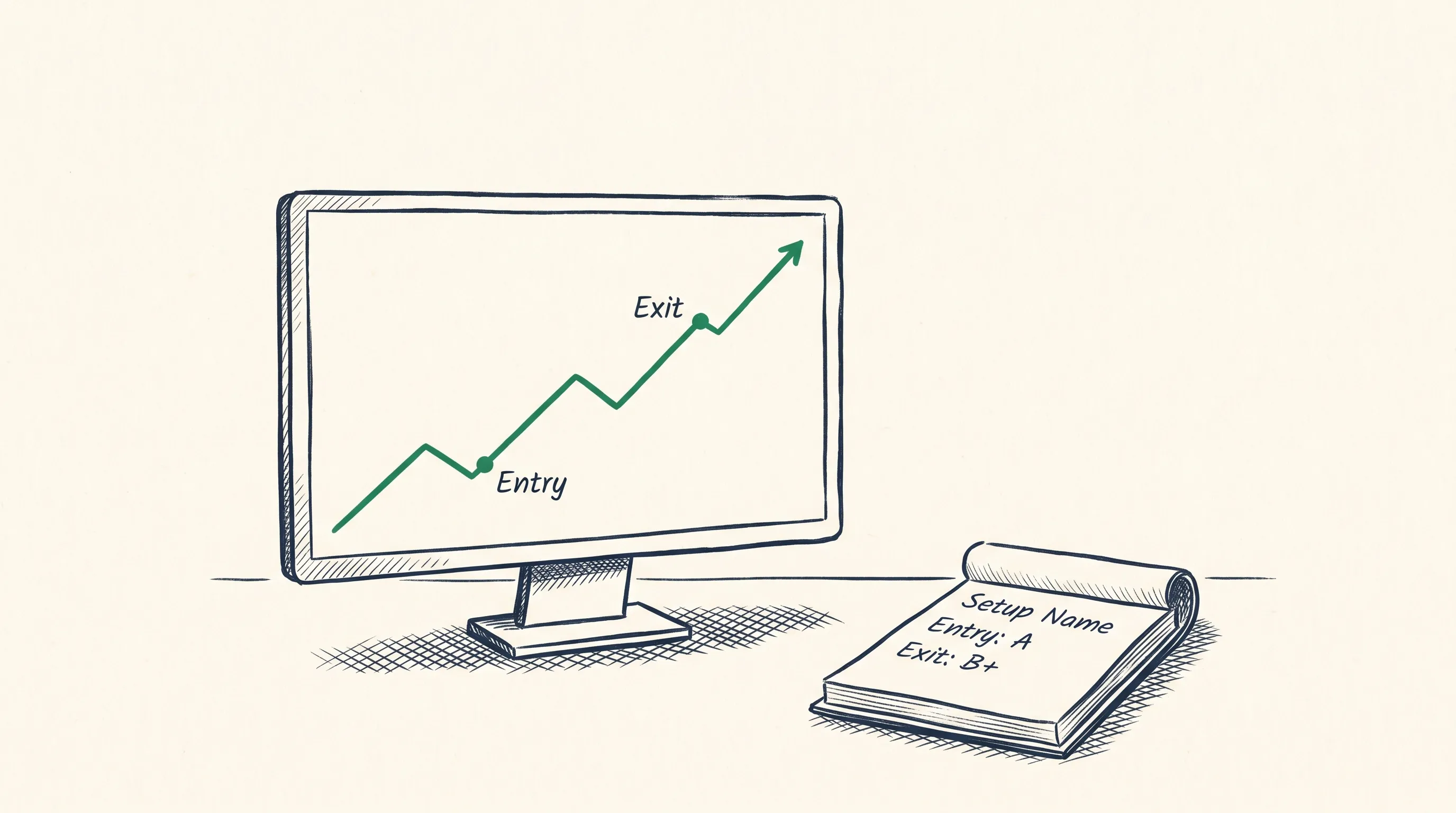
Stock traders tend to be good at spotting setups. The problem is rarely the entry. You know how to read a chart, you understand technical structure, you've studied the patterns. And yet the same mistakes keep showing up.
You exit too early on the trades that were right. You hold too long on the trades that were wrong. You perform well on certain days and give it all back on others — and you have no real idea why.
The issue isn't the setup. It's the gap between what you see on the chart and what you do about it under pressure. That gap lives in your behavior, not your technical analysis. And the only way to close it is to start tracking your trades with the right level of detail.
A stock trading journal is where that work actually happens. Not just as a log of what occurred, but as a system for understanding why it occurred — and what to do differently next time.
The Way Most Stock Traders Journal (And Why It Doesn't Work)
Most traders who journal do something like this: they write down the ticker, the entry price, the exit price, and maybe a note that says "good trade" or "should have held longer."
That's not a journal. That's a record.
The difference matters. A record tells you what happened. A journal helps you understand your behavior — and behavior is what's actually driving your results.
Think about what a record misses. It doesn't capture whether you followed your entry rules or took an impulsive entry. It doesn't tell you whether the market was trending or choppy when you traded. It doesn't show you whether you were two trades deep into a frustrating session when you made that oversized position decision. All of that context is where the real patterns live.
Without proper trading journal software, none of it gets captured, analyzed, or turned into something actionable.
What a Stock Trading Journal Actually Needs to Capture
When stock traders think about journaling, they usually start with performance metrics. Those matter — but they're the output, not the input. What you're trying to build is a feedback loop that connects your inputs (your decisions, your state, your setup selection) with your outputs (results over time).
Here's what that looks like in practice.
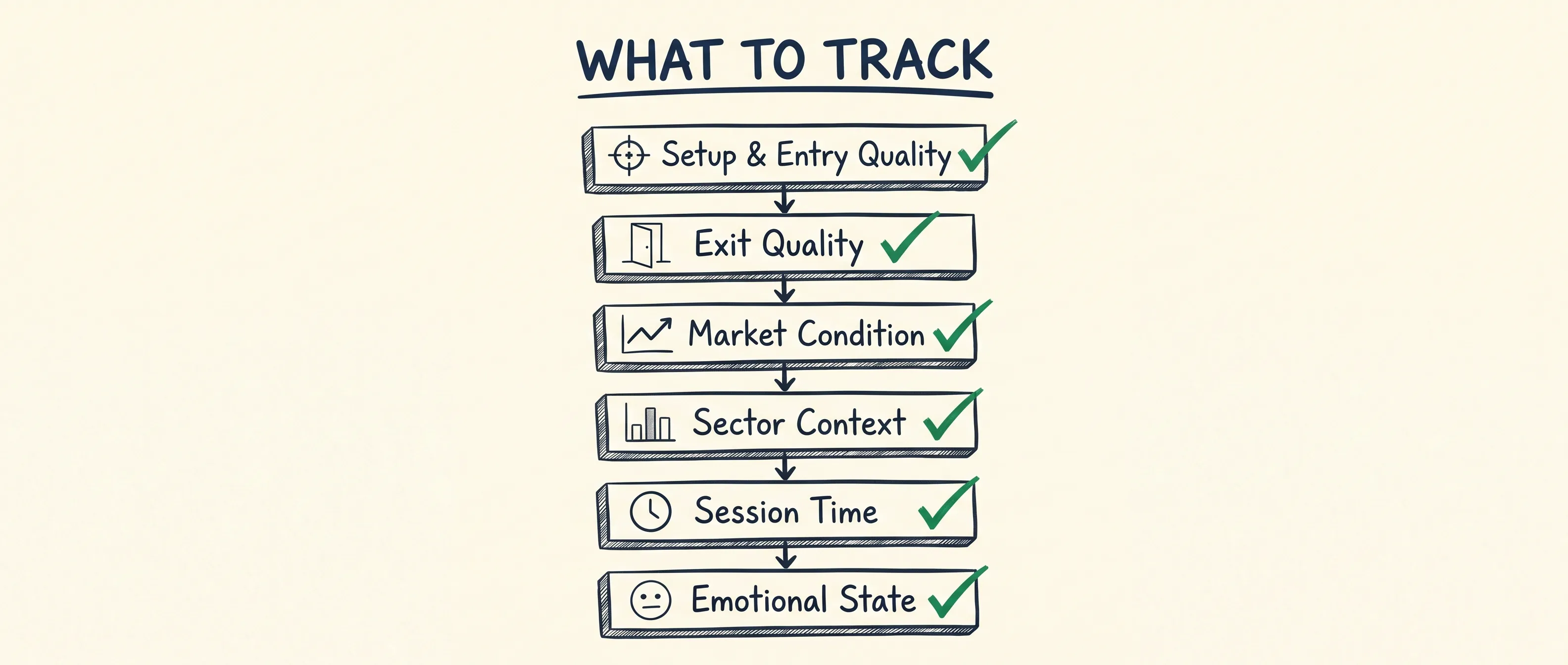
Your Setup and Entry Quality
Not just the entry price, but your reasoning. What was the setup? Was it clean or marginal? Did you enter because your criteria were met, or because you were bored and the ticker looked interesting? Over time, you'll start to see whether your highest-rated setups actually correlate with your best results — and if they don't, that's worth knowing.
Rating your entry quality on a simple 1–5 scale is one of the highest-leverage habits you can build. It forces reflection before the trade fades from memory.
Exit Quality and Trade Management
For most stock traders, exits are where edge leaks out. You can have a precise entry and still make poor decisions — cutting early, moving your stop for no reason, or holding past your target because you convinced yourself this one was different.
Logging your exit quality separately from your result gives you data on your trade management behavior rather than just your outcome. A well-managed trade that resulted in a small setback looks very different in your journal than an impulsive hold that happened to close green. Treating them the same is a mistake.
Your trade review process becomes significantly sharper when you're evaluating quality of execution, not just results.
Market Condition at Time of Trade
Stock traders often perform well in trending markets and struggle in choppy, range-bound conditions — or vice versa. The problem is they rarely track market regime as a variable.
Add a simple label to each trade: trending, ranging, news-driven, or pre-open volatile. Over 50–100 trades, you'll see patterns you could never identify from entry/exit data alone. Some traders discover their entire edge exists in one specific market condition. That's a finding worth having.
Sector and Ticker Context
Are you more consistent in technology names than in energy? Do large-cap setups behave differently for you than mid-cap? These are questions you can only answer from your own data, and they often point to an edge you didn't know you had — or a blind spot you need to address.
Session Performance by Time
Your daily trading journal should capture when you traded, not just what you traded. Many stock traders find they make the bulk of their errors in the first 30 minutes of open or in the final hour. When you can see that pattern clearly in your data, you have a concrete behavioral adjustment to make — not a vague sense that you need to "be more disciplined."
Emotional State and Decision Quality
This gets resistance from traders who take pride in being analytical. But your emotional state is data. If you were frustrated before entering a trade, or overconfident after a run of strong sessions, that context belongs in your journal. It's not therapy — it's pattern recognition.
The behavioral trading analysis that comes from this kind of data is often the most actionable insight a stock trader can extract from their journal.
The Metrics That Matter (Beyond the Basics)
Once you're tracking with this level of detail, the metrics become more meaningful. Here's what to focus on specifically for stocks.
R-Multiple tracks your results relative to your initial risk rather than in absolute terms. This normalizes your data across different position sizes and market conditions. A run of 2R results tells you something meaningful. A run of 0.3R results on entries you rated as high-quality tells you something different — and more useful.
Win rate versus expectancy — many stock traders chase win rate without understanding that it's the combination of win rate and average return per trade that determines long-run performance. You need both numbers to understand your edge.
Your risk-to-reward ratio should be tracked as planned versus actual. If you plan for a 1:3 and consistently exit at 1:1.2, that's a behavioral pattern your journal will surface — and one you can address.
Performance by setup type — if you trade three or four recurring setups, tracking results separately for each reveals which ones are generating your edge and which ones are cost centers. Many traders find that the majority of their results come from one or two setups, and the others are noise.
Errors by category — reviewing your common trading mistakes by type (entry too late, position too large, no defined exit plan) lets you prioritize what to work on rather than reviewing everything with equal weight.
How AI Changes the Stock Journaling Game
The challenge with most journaling workflows isn't intent — it's the follow-through on analysis. You log trades. You review occasionally. But you rarely have the bandwidth to sit down and run meaningful analysis across hundreds of trades, cross-referencing behavioral patterns by market condition, session time, setup type, and emotional state simultaneously.
That's where AI-powered journaling changes the picture.
A platform like ChartWise doesn't just store your trade data — it surfaces the patterns inside it. You can ask directly: "When do I perform best?" "Which setups are actually working?" "What's happening on the sessions where I give back the most?" The answers come from your actual data, not from generic trading advice.
This transforms your journal from a record into a feedback system that gets more useful every time you add a trade.
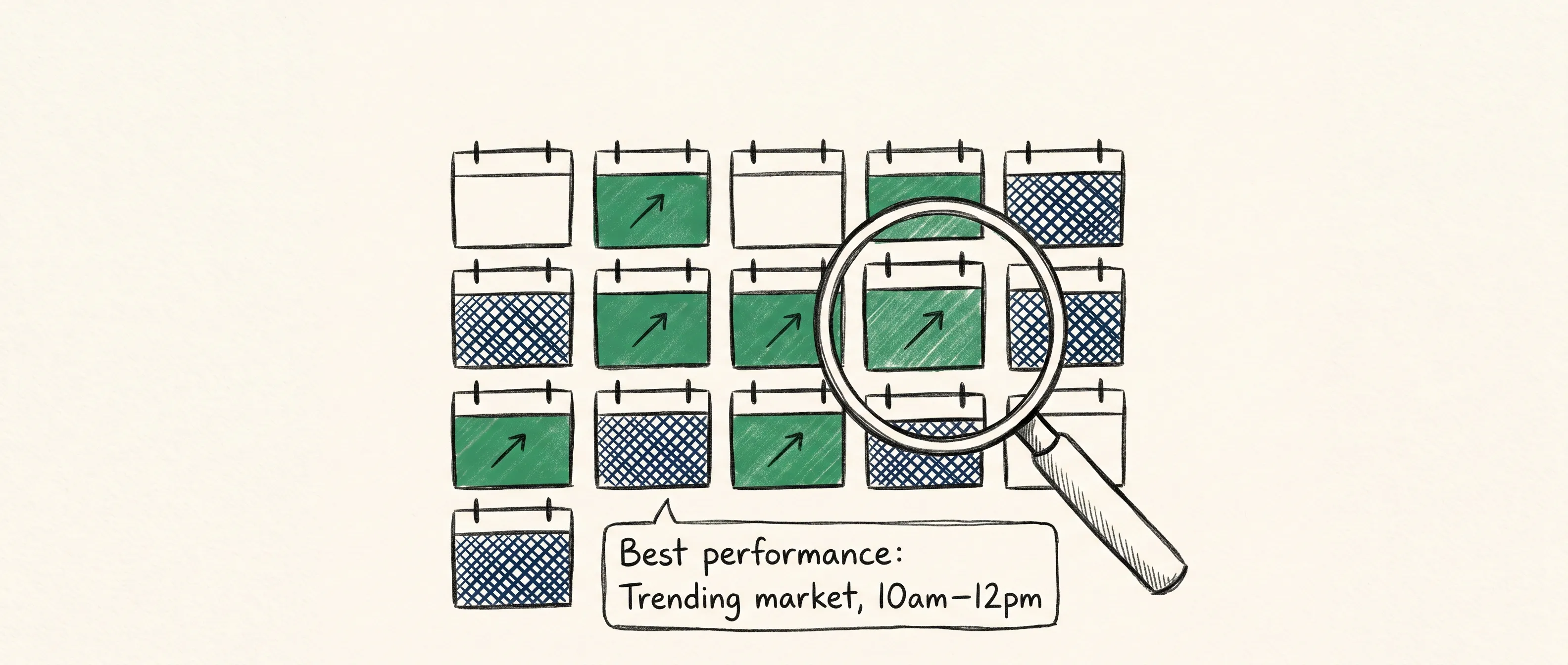
If you haven't explored what an AI trading journal can do beyond simple trade logging, the difference in what's now possible is significant.
The Role of Pre-Trade Planning
A stock trading journal is only as useful as the trades going into it. If you're entering without a defined setup, target, and exit criteria, there's nothing meaningful to review afterward.
Pre-trade planning creates the structure that makes review valuable. Before entering, note: what is the setup, where does the thesis break, and what does a good exit look like? This doesn't need to be long — two or three sentences is enough. What matters is that it's written before the trade, not after.
This habit connects directly with your trading performance tracker because it creates a benchmark against which every subsequent decision in the trade can be evaluated honestly.
Building the Habit
The most common journaling failure isn't poor execution — it's inconsistency. Traders journal for two weeks, skip a few sessions, and then abandon it entirely because the gaps in the data make the whole system feel pointless.
The fix is to make the review process shorter, not longer. A focused 10-minute end-of-day review is far more effective than a two-hour weekly session that never actually happens. Review while the trade is fresh. Rate your entry and exit quality. Note one thing you'd do differently. Close the journal and move on.
Over time, this approach — supported by trading psychology tools that track both execution and emotional data — creates a feedback loop that's hard to build any other way. You stop reacting to individual trades and start responding to patterns, which is where consistent performance actually comes from.
Why This Matters More for Stock Traders Than They Think
The stock market rewards preparation, patience, and process. Those aren't vague aspirations — they're behavioral habits that either show up in your data or they don't.
A properly built stock trading journal is how you find out which habits are working and which ones are costing you. Without it, you're operating on feel, memory, and recency bias. With it, you're operating on data.
That's not a small difference. It's the difference between a trader who keeps making the same errors and one who keeps getting better.
ChartWise is designed for exactly this — a stock trading journal that auto-imports your trades, captures what matters, and surfaces the patterns that manual review would miss.
Trade journal, read by AI.
FAQ
Q1: What should I include in a stock trading journal?
At minimum: the setup, entry quality rating, exit quality rating, market condition at the time, session period, and a brief post-trade note. The goal is to capture behavioral context, not just price data.
Q2: How is a stock trading journal different from a trade log?
A trade log records what happened. A stock trading journal captures why decisions were made and evaluates the quality of execution — which is the data that actually drives improvement.
Q3: How often should I review my stock trading journal?
Daily brief reviews are more effective than occasional long sessions. A focused 10 minutes at end of day beats a two-hour weekly review that rarely happens consistently.
Q4: What metrics matter most for stock traders?
R-multiple, planned vs. actual risk-to-reward, win rate combined with average return, and performance segmented by setup type and market condition. Results alone won't show you where the edge comes from.
Q5: Can an AI trading journal replace manual review?
No — but it enhances it significantly. AI surfaces patterns across large datasets that manual review would miss. The trader still applies judgment to what the data is showing.
Q6: How do I track market conditions in my journal?
A simple label system works well: trending, ranging, news-driven, or volatile open. Apply one label per session. Over time, the pattern of how you perform in each condition becomes clear.
Q7: What's the best way to start if I've never journaled before?
Start minimal: entry quality, exit quality, one post-trade note. Build the habit first, add more fields as the review process feels natural. Consistency over completeness in the first 30 days.