Scalping Trading Journal: How to Track High-Frequency Trades and Build Real Edge
Scalping is the most demanding form of active trading. Entry windows last seconds. Setups repeat thirty, forty, sometimes sixty times in a session. And the margin between a disciplined scalper and an impulsive one rarely shows up in individual trades — it shows up in the aggregate, over hundreds of repetitions, buried in data that most traders haven't been collecting carefully enough.
A scalping trading journal isn't a nice-to-have. It's the only instrument that turns that volume of activity into legible feedback. This guide covers what makes scalping journaling different, what it needs to capture, and how to build a review process that actually sharpens edge over time.
Why Standard Journals Fall Short for Scalpers
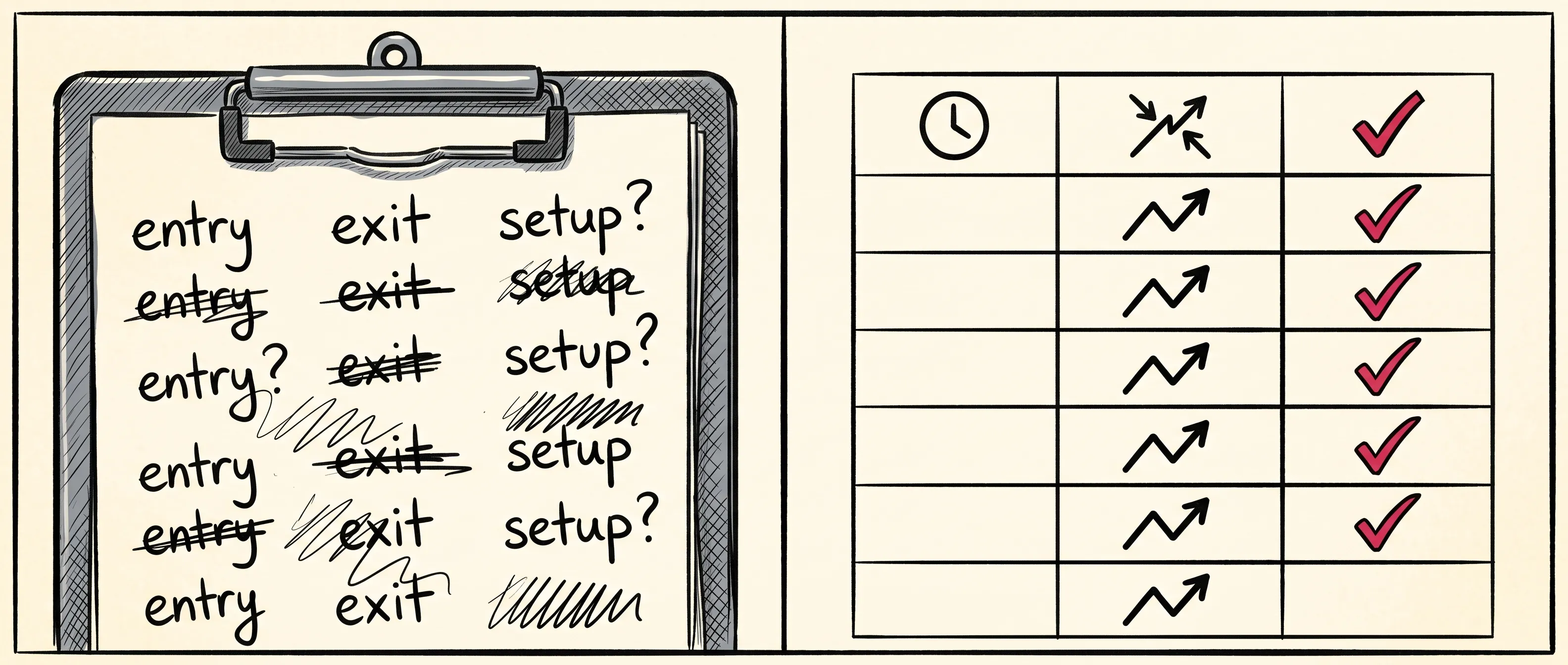
Most trading journal templates are built around swing and position traders. They have columns for entry, exit, setup name, and outcome. For someone who holds trades overnight and reviews a handful of setups per week, that format is adequate.
For a scalper taking forty trades before noon, it breaks down fast.
The problems are structural:
Volume strain. Manual entry after every scalp is impossible mid-session. By the time you log trade twelve, you've already taken fifteen. Discipline degrades because the format demands too much from the wrong moment.
Missing time granularity. Scalpers need data by session phase — first fifteen minutes, midday chop window, close-of-day momentum. A generic date/time field doesn't give you that.
Setup speed confusion. When setups appear in two-to-five-second windows, context — what preceded the entry, what the tape was doing — evaporates within minutes of the trade. Standard note fields assume you'll remember. You won't.
Emotional cycle speed. Swing traders have hours to recover between trades. Scalpers experience the full cycle of urgency, regret, and recovery inside thirty seconds. Standard emotion fields don't capture the velocity of this.
A purpose-built scalping trading journal treats volume not as a burden but as the core data asset.
What a Scalping Journal Needs to Track
Not everything needs equal depth. The goal is capturing the minimum signal necessary to identify patterns across hundreds of trades.
Session-phase tagging. Every trade should be tagged by market phase: pre-market, open range, mid-session drift, close. Over enough data, this single variable reveals which phases of the day you perform in, and which ones reliably cost you. Most scalpers have a clear peak window they've never formally verified.
Setup classification. Keep setup names short and consistent — breakout, pullback, momentum reversal, failed breakdown. The names don't need to be elaborate. They need to be applied identically, trade after trade, so the dataset is comparable across sessions.
Execution quality tracking. In scalping, the difference between a precise entry and a rushed one is often just a few ticks. Execution quality — entered as planned, chased, hesitated — is one of the highest-value fields in any scalping journal. It separates setup quality from execution error, two things that look identical on a standard performance report.
Consecutive trade context. Some of the most important data a scalper can collect isn't about individual trades — it's about sequences. What happened in the three trades before this one? Was this a recovery attempt after a stop? Consecutive context fields capture the behavioral drift that causes late-session damage.
Emotional state at entry. Not a mood diary — a simple rating. Calm, slightly elevated, elevated, reactive. Combined with setup and execution quality data, this field often explains why the same setup produces inconsistent outcomes across sessions.
These fields don't require paragraphs. A modern trading journal software platform captures them in seconds per trade through dropdowns and pre-set tags, leaving the detailed reflection for post-session review. Manual typing during a live scalping session destroys both focus and accuracy — the tool should minimise friction to near zero.
Building a Scalping Review Process That Works
High-frequency trading creates high-frequency data. Without a structured trade review process, that data piles up and goes unused. Most scalpers who "keep a journal" are actually keeping a log — they record trades but never extract insight from them.
A review process has three layers for scalpers:
Daily micro-review (5 minutes max). Immediately after the session ends, while context is fresh: note the phase you were sharpest in, flag any trade where you overrode your plan, and rate overall execution discipline. This isn't analysis — it's tagging while memory is still alive. Think of it as the final step of your daily trading journal routine.
Weekly pattern review (20–30 minutes). Pull the week's data and look for distribution patterns across your tagged fields. Where did your best setups cluster — by time of day, market condition, session phase? Where did execution quality degrade? If you use analytics software, this is where filtering by setup type against session-phase data starts revealing edges you didn't know you had.
Monthly behavioral audit. Look at the emotional state field across the month. Cross-reference elevated states with execution quality and consecutive-trade context. This is typically where scalpers first see the precise cost of trading through fatigue or frustration — not as a feeling, but as measurable pattern degradation. This kind of analysis is what turns trading insights from a concept into an actual practice.

Common Scalping Journal Mistakes
Even traders who commit to journaling often fall into patterns that limit what they get from the data.
Logging outcomes only. Scalpers who record only whether a trade worked miss everything that explains why. A journal that's just an outcome record won't tell you that you perform consistently on opening-range setups but steadily give it back during mid-session reversals.
Inconsistent setup naming. "Breakout" in one session, "BO" in another, "momentum play" in a third — these are the same setup, but the data doesn't know that. Inconsistent labelling is one of the most common common trading mistakes journal-keepers make, and it quietly destroys the analytical value of weeks of data.
Skipping the difficult sessions. The sessions most worth reviewing are the ones that felt worst. Scalpers who only journal when trading is going well create a biased dataset. The resistance to logging a difficult session is precisely why it matters — acknowledging it honestly is the foundation of emotional trading solutions that actually hold up over time.
Over-granular note-taking mid-session. Writing detailed trade notes during a live scalping session is a focus problem disguised as discipline. The best scalping journals minimise the in-session load and front-load the review. Short tags during the session; structured analysis after.
Scalping Journals and Prop Firm Evaluation
For scalpers on evaluation accounts, the journal isn't optional — it's infrastructure. Most prop firm rules impose daily drawdown limits, consistency requirements, and trade frequency parameters. A scalping journal that tracks session-phase performance and execution quality becomes a compliance tool alongside a learning one.
Understanding when you approach your daily limit relative to session phase, and which setup types produce the most variance in your execution, is what allows a scalper to structure their activity within prop firm parameters rather than trading reactively until the system flags them. If you're navigating an evaluation, the prop firm trading journal guide covers this in detail.
The practical implication: if your journal shows that the majority of your drawdown happens after 11:30 AM, that data directly informs a rule. If you can't see it, you can't act on it.
What to Look For in a Scalping-Oriented Analytics Platform
Not every journaling tool handles scalping volume well. When evaluating an analytics platform for high-frequency trading, these capabilities matter most:
Fast trade import or broker sync. Manual entry for fifty daily trades is unsustainable. Auto-import from your broker or trading platform is the baseline requirement.
Session-phase and time-of-day filtering. You need to slice performance by intraday time windows, not just by calendar date. Platforms that can only report by day or week miss the most important scalping insight layer.
Execution quality fields. Does the platform allow you to tag how you entered — planned, chased, hesitated — as a standard field? Most generic journals don't include this, leaving a critical data point invisible.
Behavioral pattern detection. The most useful scalping data isn't in individual trades. It's in sequences, streaks, and the relationship between emotional state and execution consistency. AI-assisted tools that surface these patterns automatically reduce the review workload significantly and make pattern recognition reliable rather than intuitive.
ChartWise was built with high-frequency trading in mind. The platform supports auto-import, session-phase analytics, behavioral pattern detection, and an AI assistant that answers questions about your own data in natural language. If your current setup makes scalping volume feel like a data burden, it's worth seeing what purpose-built analytics actually looks like.
Building Long-Term Edge Through Scalping Data
Edge in scalping is narrow. The setups that work during the opening range may not translate to the mid-session drift. The state you're in at trade forty may be structurally different from trade five. A scalping trading journal doesn't just document — it reveals the specific conditions under which your edge holds and the conditions under which it deteriorates.
That information won't surface from a spreadsheet, and instinct alone won't see it clearly. The scalpers who improve systematically are the ones who've turned their session data into a feedback instrument — one they run consistently, review honestly, and use to make deliberate decisions about how and when they trade.
If you're still piecing this together manually, the overtrading solutions guide is a practical complement — overtrading and impulsive scalping are often the same problem seen from different angles. Consistent logging, structured review, and pattern-aware analytics are what separate the scalpers who improve from the ones who stay stuck repeating the same costly sessions indefinitely.
FAQ
1. What should I track in a scalping trading journal?
At minimum: session phase (open range, mid-session, close), setup type, execution quality (planned/chased/hesitated), emotional state at entry, and consecutive trade context. These five fields together provide more actionable insight than outcome data alone.
2. How is a scalping journal different from a standard trading journal?
Standard journals are built for lower-frequency strategies and assume you have time to write detailed notes per trade. A scalping journal prioritises speed of capture, session-phase granularity, and behavioral sequence tracking — things that matter specifically when you're taking twenty to sixty trades per session.
3. How do I journal when I'm taking 30–50 trades a day?
Use pre-set tags and dropdowns for in-session capture — one or two seconds per trade. Detailed reflection belongs in the post-session review, not during live trading. Any platform requiring you to type full notes mid-session is the wrong tool for scalping.
4. What time of day should I review my scalping trades?
Immediately after the session for a five-minute micro-review while context is fresh. A deeper weekly review of twenty to thirty minutes is where meaningful pattern analysis happens. Monthly behavioral audits are where you cross-reference emotional state data against execution quality over time.
5. Can scalpers use ChartWise for their trading journal?
Yes. ChartWise supports auto-import from major brokers, session-phase analytics, execution quality tracking, and an AI assistant that surfaces behavioral patterns across your trade history. It's built to handle high-frequency volume without making logging a manual burden.
6. Why is session-phase data important for scalpers?
Most scalpers perform significantly better in certain intraday windows — often the opening range — and give it back in others. Without session-phase tags, this pattern is invisible. With them, it becomes a concrete rule: trade heavily in your peak window, reduce size or stop trading in your weak window.
7. What are the most common scalping journal mistakes?
Logging outcomes but not execution quality, using inconsistent setup names that break data comparability, skipping difficult sessions instead of reviewing them, and trying to write detailed notes mid-session rather than using quick tags followed by a structured post-session review.