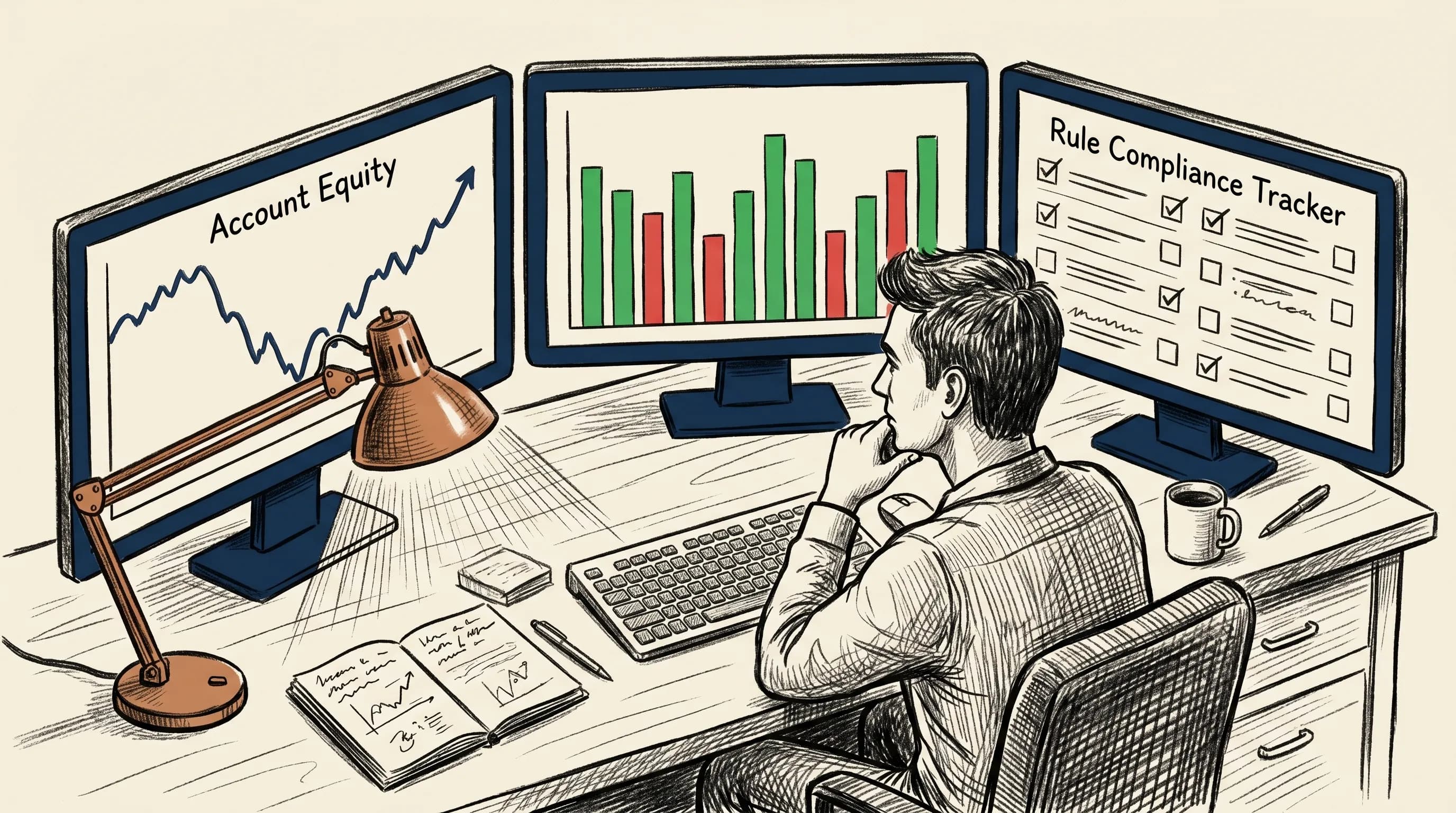
There's a very specific kind of silence that happens when a prop firm challenge fails.
Not after one bad trade. After the fifth bad trade — the one where you already knew it was wrong the moment you entered. But the drawdown clock was running, the target felt reachable, you sized up slightly to recover faster, and then held a little too long. Account hit the daily limit. Challenge over.
Most traders who fail prop firm challenges don't fail because they can't trade. They fail because they had no system for monitoring their own behavior under pressure. And pressure, in prop trading, is structural. It's built into the rules.
This is the problem a prop firm trading journal solves — not by teaching you to trade, but by giving you the data to see clearly when pressure is distorting your decisions.
What Makes a Prop Firm Challenge Different From Regular Trading
A self-funded trader can absorb a bad week and recover slowly. A prop firm trader cannot. The rules are fixed and unforgiving:
Maximum drawdown limits — typically 8–10% trailing or static
Daily loss limits — usually 4–5% per day
Minimum active trading days — often 10 days minimum
Profit targets — typically 8–10% to pass Phase 1, 5% for Phase 2
Consistency rules — some firms require no single day account for more than 30–40% of total gains
These constraints transform trading from a craft into a constrained performance problem. And most traders approach challenges with habits built in demo or retail accounts — where none of those constraints existed.
The result? They size up too early chasing targets. They revenge trade after brushing the daily limit. They take low-quality setups in the final days when patience would have been the better play.
None of this is a skill problem. It's a self-awareness problem. And that's precisely what a structured trading journal addresses.
What Your Prop Firm Trading Journal Must Track
Not all trading journals are built for the prop firm environment. A generic journal that records entry, exit, and ticker isn't enough. Here's what genuinely matters when you're operating under challenge conditions.
1. Daily Drawdown Used vs. Limit
Every session, you need to know where you stand against the daily loss rule — not at the end of the day, but during it. If your firm allows a 4% daily limit and you've used 2.8% by noon, your entire decision framework should shift. Your journal should surface this automatically, not leave you doing mental arithmetic mid-trade.
2. Account Drawdown vs. Maximum Limit
The trailing or static maximum drawdown is the challenge-ender. Most traders know their limit in theory. Fewer track their actual proximity to it in real time. A well-structured trading performance tracker shows you current equity relative to worst-case — and many traders are surprised by how close they are.
3. R-Multiple Per Trade
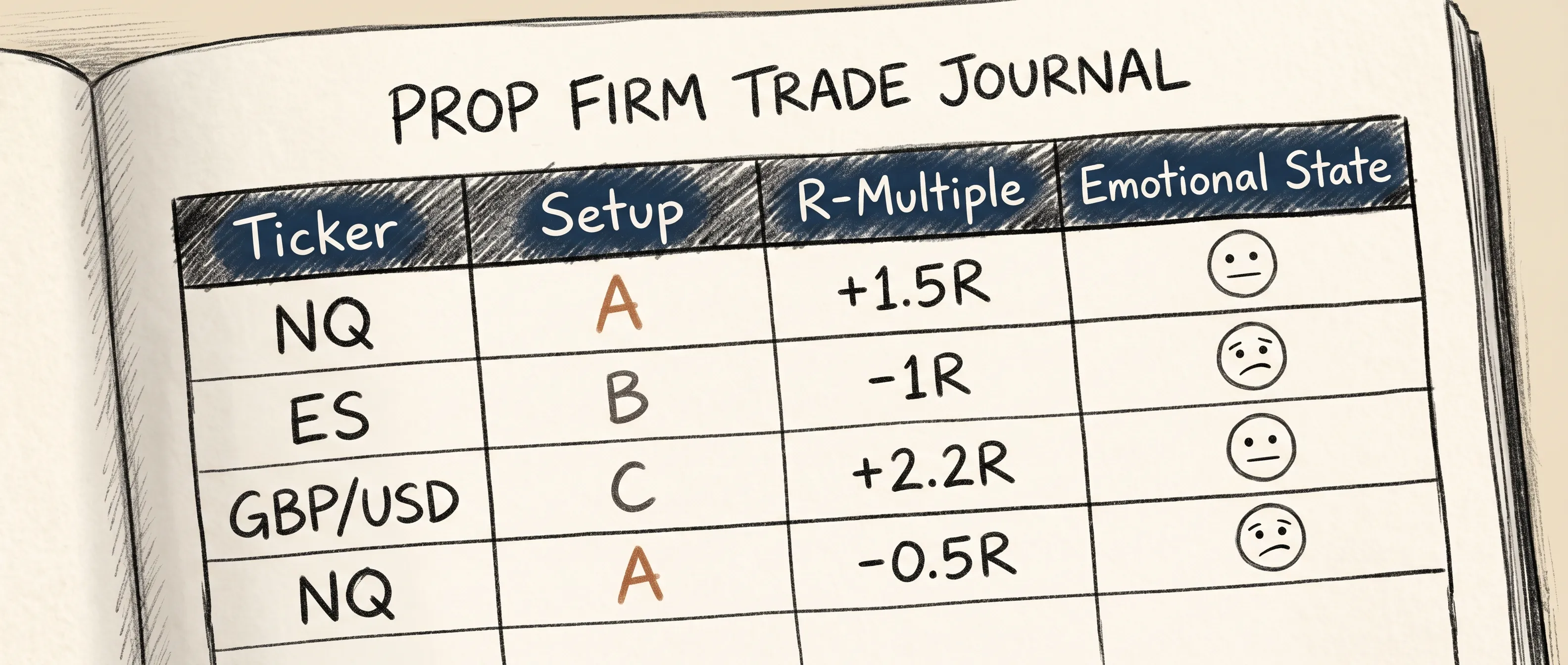
Prop firm rules reward consistency, not home runs. Tracking your R-multiple — how much you risked versus how much you captured — is the single most important variable for understanding whether you're trading with edge or on emotion. A positive expectancy across 30+ trades is what earns funded status. Erratic R-multiples signal emotional interference.
4. Setup Quality Rating
Before every trade, assign a rating: A, B, or C. After the session, check whether your A setups performed differently from B and C. Most prop firm traders discover they've been taking too many C setups — trades that feel valid in the moment but don't meet their own criteria on review. Removing C setups often makes more performance difference than any technical adjustment.
5. Emotional State at Entry
This is the metric traders skip most often — and the one that matters most in a challenge environment. Logging your emotional state at entry (calm, anxious, frustrated, revenge-minded) takes ten seconds. Over two weeks of challenge data, the pattern becomes undeniable: certain states consistently precede certain outcomes. This isn't theory. It's your data. Our trading psychology tools guide covers this in detail.
6. Time-of-Day Performance Breakdown
Prop firm traders almost always have a session window where they consistently underperform. Morning open volatility destroys some traders. Lunchtime chop destroys others. Your journal will surface this pattern by the end of your first challenge week — and that's information that can save an account.
7. Position Size Relative to Drawdown Remaining
This is the discipline check. As drawdown deepens, rational position sizing should decrease — not increase. Failed challenges consistently show the opposite: traders size up as they fall behind, attempting rapid recovery. Your journal should track position size alongside drawdown remaining so this pattern becomes visible before it becomes irreversible. See our position sizing guide for the underlying framework.
How Journaling Helps You Pass the Challenge Phase
The challenge phase is psychological stress-testing as much as technical testing. The rules are specifically designed to filter out traders who cannot maintain discipline under constraint.
Here's what systematic journaling does for challenge performance:
It removes the fog. Traders under challenge pressure often believe they have a clear picture of their account — and they rarely do. They round numbers, forget slippage, misremember yesterday's high-water mark. Your journal doesn't misremember anything.
It creates a behavioral mirror. When you review a week of entries and notice that your worst days follow a consistent sequence — large morning loss, break, afternoon revenge entry — the pattern isn't abstract anymore. It's evidence. Specific, actionable evidence about how you respond to adversity.
It enforces pre-trade discipline. The act of logging a setup before entry — articulating the reason, the invalidation point, the target — creates a micro-commitment. You're less likely to abandon a well-defined plan under pressure. And you're less likely to enter a trade you can't articulate in the first place.
It closes the feedback loop. Without a journal, most traders complete a challenge — pass or fail — without fully understanding what drove the outcome. With a journal, every decision is on record. The review tells you exactly what to repeat and what to eliminate before the next attempt.
Staying Funded: What to Monitor After the Challenge
Passing the challenge is the first gate. Staying funded is the actual job. Many traders treat the funded phase as a pressure release — the rules feel softer, the urgency lower. They're not. The constraints are different but the stakes are higher: real payouts, account reviews, potential scaling decisions.
Your behavioral trading analysis should continue with the same rigor post-challenge. Specifically:
Monthly edge review. Every 30 days, review your expectancy across all funded trades. Is your edge holding? Improving? Degrading? Firms that offer account scaling typically look for evidence of consistent positive expectancy, not a single large month followed by volatility.
Drawdown trend monitoring. Even within allowed limits, a gradual drift toward maximum drawdown is a warning signal. Identify it at 50% of the limit, not 90%.
Strategy drift detection. Funded traders frequently start taking setups outside their proven methodology — exploring new markets, importing techniques from trading communities, adjusting their rules mid-month. Your journal makes strategy drift visible immediately through setup-type tracking.
Pre-session planning continuity. The discipline that passed the challenge should persist into the funded phase. Your journal's pre-session plan — watchlist, entry criteria, maximum daily exposure — is not challenge scaffolding. It's your operating framework.
The AI Advantage in Prop Firm Journal Analysis
Manual journaling works. It's significantly better than no journaling. But it has a ceiling: the patterns you find are the patterns you already know to look for.
AI-assisted performance analytics removes that ceiling. When every trade across your challenge is logged — entry, exit, setup type, emotional state, position size, time, market context — an AI layer surfaces correlations that manual review would miss. Not just "you trade better in the morning" but "you perform best on days following a rest day, in the first 45 minutes of the session, when your setup type is a pullback rather than a breakout."
That granularity changes how you prepare for funded months.
ChartWise's AI assistant can be queried in plain language across your complete trade history — "show me my worst setups when daily drawdown exceeded 3%" — and surface answers within your journal context, without requiring spreadsheet construction or manual data sorting. It's built for traders who want insight without administrative overhead.
Combined with automatic trade import and a structured daily review framework, it compresses the feedback loop between trading behavior and behavioral understanding. For a prop firm trader operating under time and drawdown pressure, that compression matters. Explore the full AI trading journal capability set for more.
Common Journaling Mistakes Prop Firm Traders Make
Only logging after good sessions. Your worst days contain the most diagnostic information. Force the review when it hurts.
Vague entry notes. "Bad trade, broke my rules" is useless at day 12. "B-setup on NQ, entered three minutes before a news event, stopped out for -1.2R" gives you something to act on.
No pre-session plan. Post-trade logging captures only half the picture. Write your plan — watchlist, entry conditions, maximum risk for the session — before the open. Your end-of-session review then has a reference point rather than just a record.
Reviewing too infrequently. Weekly review is the minimum viable frequency. Daily is better. During an active challenge, a five-minute end-of-session review can catch a deteriorating behavioral pattern before it reaches the drawdown limit.
Abandoning the journal after passing. The challenge ended. The journaling should not.
ChartWise for Prop Firm Traders
ChartWise is performance analytics software — not a signal service, not a strategy platform. It's a structured environment for traders who need to understand their own behavior, not guess at it.
For prop firm traders specifically, ChartWise delivers:
Automatic trade import via secure broker connection — no manual data entry between sessions
R-multiple, MFE, and MAE tracking per trade — the metrics that reveal genuine edge quality over large sample sizes
AI assistant queryable in plain language across your complete trade history
Daily performance metrics — session-by-session equity, trade frequency, setup distribution
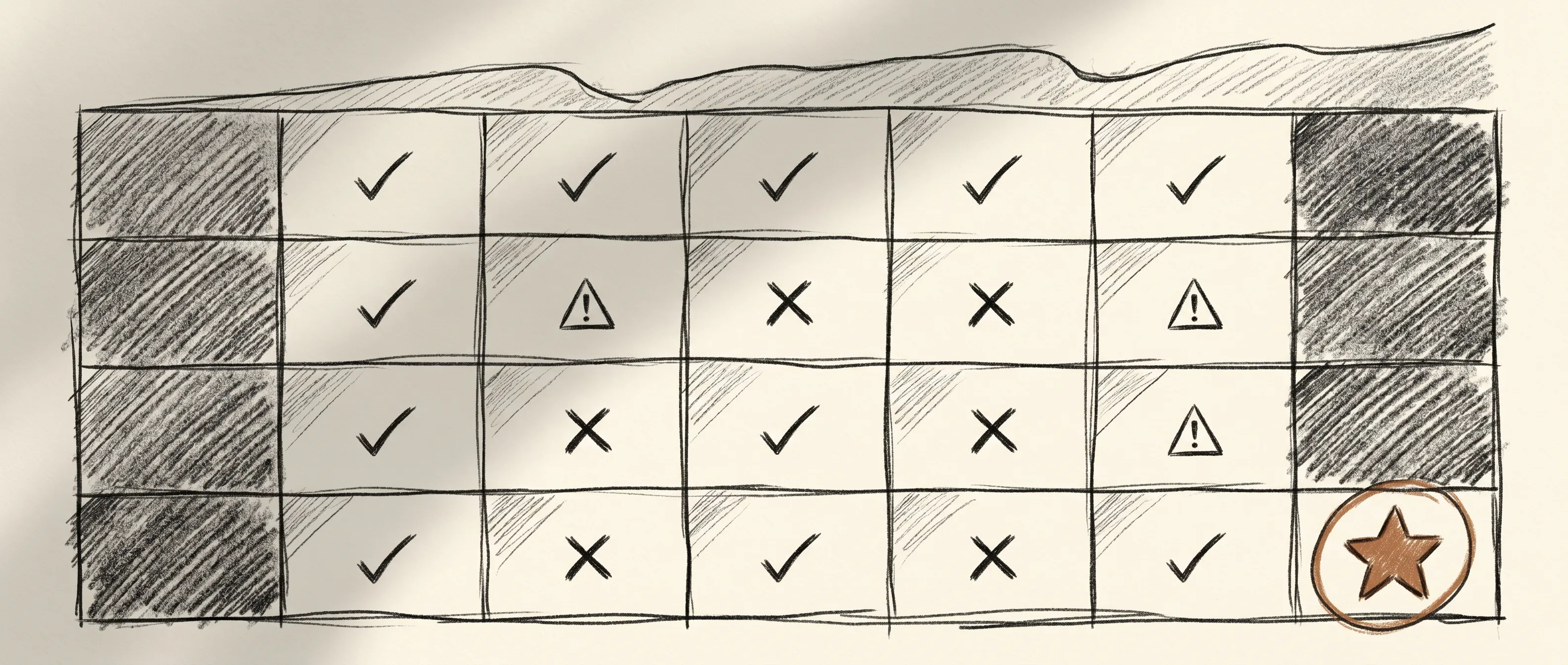
Smart calendar view — challenge progression mapped chronologically, so you can see behavioral trends across the full challenge timeline
Whether you're on a Phase 1 attempt or managing a scaled funded account, ChartWise gives you the analytical layer that turns raw trade data into actionable behavioral insight.
Join the waitlist at chartwise.app.
The Bigger Picture
Prop firm trading is among the most demanding environments in retail trading — not because of technical complexity, but because of constraint structure. You're asked to perform at your best inside a rule set deliberately designed to punish emotional decisions.
The traders who consistently pass challenges and stay funded are not always the most technically skilled. They're the most self-aware. They know their patterns. They know their triggers. They know their edge — because they've measured it.
A prop firm trading journal doesn't make you a better trader overnight. But it shows you, in your own data, exactly what better looks like.
Start there.
FAQ
1. What is a prop firm trading journal?
A prop firm trading journal is a structured record-keeping system specifically designed for traders participating in funded account challenges or managing funded trading accounts. Unlike a general trade log, a prop firm journal tracks challenge-specific metrics — daily drawdown used, account drawdown proximity, consistency rule compliance, setup quality, and emotional state — alongside standard trade data. It exists to make behavioral patterns visible under the pressure conditions that prop firm rules create.
2. What should I track in a prop firm challenge journal?
At minimum: daily drawdown used versus limit, overall account drawdown versus maximum, R-multiple per trade, setup quality rating (A/B/C), emotional state at entry, time-of-day performance, and position size relative to remaining drawdown. These seven metrics cover the full picture — technical execution, risk discipline, and behavioral state — that determines whether a challenge succeeds or fails.
3. Can I use a regular trading journal for prop firm challenges?
You can, but a generic journal has limitations. Most standard journals record entry, exit, and setup without challenge-specific context — drawdown proximity, daily limit usage, consistency rule tracking. A journal designed around prop firm conditions will surface the relevant patterns faster and more clearly. If you're using a general tool, customise it to include the challenge-specific metrics listed above.
4. How often should I review my prop firm trading journal during a challenge?
Daily end-of-session review is strongly recommended during any active challenge. A five-minute review per session — comparing actual behavior against your pre-session plan — can catch a deteriorating pattern well before it reaches a drawdown limit. Full weekly review is the minimum. For funded accounts, monthly edge reviews are essential alongside the daily practice.
5. What's the most common journaling mistake prop firm traders make?
Only logging after good sessions, and keeping entries vague after difficult ones. The days where decisions broke down contain the most diagnostic information. Specific logging — setup type, entry rationale, market context, emotional state — on losing days is where the most behavioral insight comes from. Traders who avoid reviewing their worst sessions tend to repeat them.
6. How does AI help with prop firm trading journal analysis?
AI analysis identifies correlations across large trade datasets that manual review would miss. Rather than searching for patterns you already suspect, an AI assistant can surface unexpected relationships — specific setup types underperforming in certain session windows, emotional states correlating with position sizing decisions, drawdown depth affecting exit behavior. For prop firm traders with limited time between sessions, AI compresses the analysis cycle substantially.
7. Does ChartWise support prop firm account tracking?
ChartWise is built as performance analytics software with automatic trade import, R-multiple and MFE/MAE tracking, an AI assistant queryable in plain language, and a smart calendar view for session-by-session performance mapping. These tools directly serve prop firm traders at both the challenge and funded account stage. Join the waitlist at chartwise.app to be notified at launch.