Options are a different game.
You already know that. The problem is most journals don't.
The majority of trading journal software was designed around equities and forex. Log your entry. Log your exit. Check your result. Done. For a stock trade, that captures most of what matters. For an options trade, it captures maybe 40% of it.
The other 60%—the strategy type, the IV environment, the Greeks at entry, the time decay curve, the roll decision, the reason you closed early—gets lost. And that's exactly where options traders bleed.
This isn't a rant against generic journals. It's an explanation of why journaling for options traders needs to work differently, and what a proper options trading journal actually has to capture.
Why Options Are Harder to Journal
When you buy a stock at $50 and sell at $55, the story is simple. Price went up. You made money. The journal entry almost writes itself.
Options don't work that way.
You can buy a call option on a stock that goes up $3 and still lose money. You can sell a put spread that never gets touched and profit from nothing happening. You can watch a trade go perfectly on price and still get destroyed by IV crush the morning after an earnings announcement.
In options, the outcome isn't just about direction. It's about direction, volatility, time, and how well your strategy was matched to the market environment.
If your journal only captures price movement and final result, you're missing the entire conversation.
The Core Problem: Logging Outcomes Without Context
Most options traders fall into one of two habits.
The first group doesn't journal at all. The position closes, they move on, and nothing gets retained for review. The wins feel like skill. The losses feel like bad luck. Nothing changes.
The second group logs trades diligently—strike price, premium paid, expiry date, final outcome—but doesn't capture the why behind any decision. They have data, but no story. When they go back to review, there's nothing to learn from. Numbers without context don't teach you anything.
The result in both cases is the same: the same mistakes repeat. The same IV environments catch you off guard. The same emotional triggers cause early exits. The same size errors compound small errors into big ones.
A proper options journal fixes this not by asking you to write more, but by making sure you capture the right things while the trade is alive.
What to Log for Every Options Trade
Here's what a complete options journal entry looks like. Not every field applies to every trade, but the closer you get to this, the more reviewable your data becomes.
Before the trade:
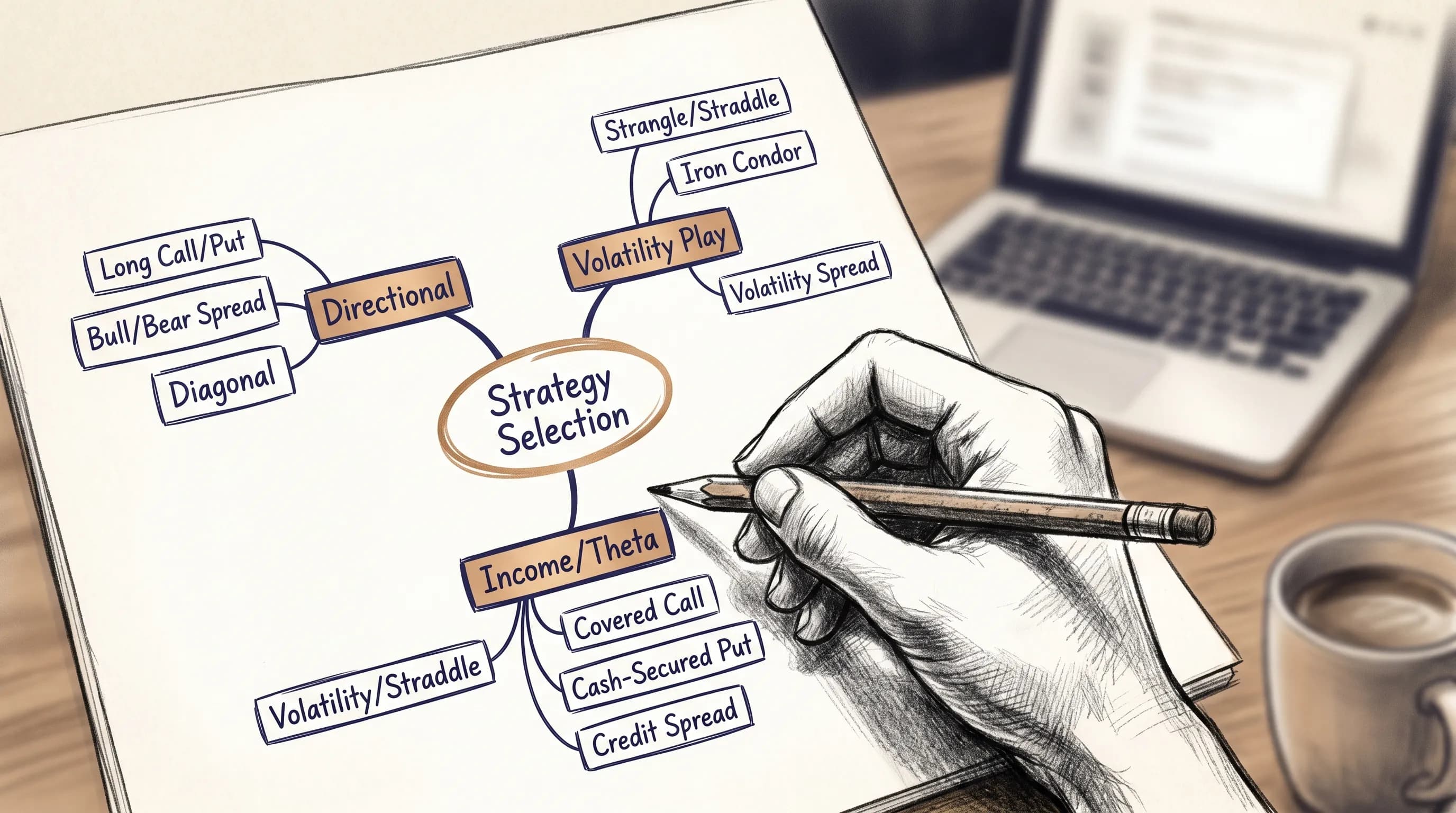
Strategy type — covered call, long call, put spread, iron condor, strangle, butterfly, etc. Labelling this upfront forces clarity on what you're actually trying to do.
Trade thesis — is this a directional play, a volatility play, or an income/theta trade? These have completely different success criteria.
IV Rank or IV Percentile at entry — were you buying in a low-IV environment or selling in a high-IV environment? This single data point explains more about your options results than almost anything else.
Delta at entry — how much directional exposure were you starting with?
DTE (Days to Expiry) — how much time were you working with?
Underlying price vs strike — were you ATM, ITM, or OTM? By how much?
Max risk and max reward — not the risk-to-reward ratio in abstract terms, but the actual dollar figures defined by your structure.
Plan for adjustment or exit — what would cause you to roll, close, or add to this position?
During and at close:
What changed — did IV expand or contract? Did the underlying move as expected, sooner, later, or not at all?
Why you exited when you did — did you hit your target? Did you get scared? Did time decay take the position where you wanted it?
Roll decision — if you rolled, why? Did rolling serve the trade or delay an exit you should have taken?
Emotional state — were you calm and following the plan, or reactive?
This is more than most traders track. But it's also the minimum needed to actually learn from an options trade after the fact.
The IV Problem Nobody Talks About
Implied volatility is the most misunderstood variable in options trading, and the one most journals completely ignore.
Buying options when IV is elevated means you're paying a premium that can evaporate even if you're right on direction. Selling options in a low-IV environment means your premium collected is thin and your risk-reward is compressed. Getting the IV environment right matters as much as getting the direction right on many setups.
Without logging IV rank at entry, you can't identify patterns like:
"I keep losing on long options because I'm buying after big moves when IV is already spiked"
"My short premium trades perform best when IV Rank is above 50"
"I systematically underestimate theta decay in the last two weeks before expiry"
These aren't abstract lessons. They're patterns that only surface when you have consistent data across dozens of trades in different IV environments. Your journal is how you collect that data.

Multi-Leg Strategies Need Multi-Leg Thinking
If you trade spreads, condors, or strangles, logging individual legs separately creates a misleading picture.
A put spread that collected $1.20 in premium with a max risk of $3.80 needs to be evaluated as a structure, not as two separate positions. If you log each leg independently, your trading performance tracker will show a confusing mix of "wins" and "losses" that don't reflect the reality of how the strategy performed.
What matters for a multi-leg trade:
Net premium collected or paid
Maximum risk of the structure
How the structure behaved as the underlying moved
Where you were in the profit zone when you exited
Whether you let a winner run too long and gave back gains
Most generic journals can't hold this complexity. Either they force you to log it awkwardly across multiple entries, or they collapse it into a single number that strips out all the useful information.
The Behavioral Analysis Layer
Options decisions are some of the most emotionally influenced decisions in trading. The complexity of the instrument makes it easier to rationalize bad behavior.
"I'll let it run. It might still get there before expiry." That's a sentence that costs options traders thousands every year.
"I closed it early. I was nervous about theta." Sometimes that's discipline. Sometimes that's fear costing you a trade that would have worked.
Without logging your emotional state and decision rationale at entry and exit, you can't tell the difference. You look back at an early close and have no idea whether it was smart risk management or anxiety-driven mistake. The outcome alone doesn't tell you.
This is where trading psychology and journaling genuinely intersect. The goal isn't therapy. It's pattern recognition. If you can see that you consistently close profitable spreads early when the underlying moves against you briefly, that's actionable. If you can see that you hold losing positions longer than your plan allows, that's actionable too.
You can't see those patterns in a spreadsheet that only logs strike prices and premiums.
How Often to Review an Options Journal
Options don't require daily journaling in the same way that day trading does, but they do require structured periodic review.
After every trade closes — spend five minutes capturing what happened relative to your original thesis. Not a full analysis. Just the key difference between what you expected and what actually occurred.
Weekly — look across all open positions. Are any of them deviating significantly from the original plan? Do any need adjustment, or are you holding because the plan is intact?
Monthly — review closed trades by strategy type. Which structures performed best in the current volatility environment? Are there consistent mistakes at a particular DTE, delta level, or IV condition?
The trading journal challenge most options traders face isn't motivation. It's structure. Without a clear framework for what to log and when to review, journaling becomes inconsistent and loses its value.

Where an AI Trading Journal Fits In
The reason most options traders don't journal well isn't laziness. It's that the mental overhead of capturing everything described above feels like a second job on top of an already complex activity.
An AI trading journal changes this by handling the structural parts automatically. Trade data syncs without manual entry. Multi-leg structures are recognized as units, not individual legs. Greeks, IV, and DTE can be captured at the moment of entry without you typing them out one field at a time.
What's left for the trader is the qualitative layer — the thesis, the emotional state, the exit decision — which takes seconds to log when everything else is already filled in.
More importantly, AI can surface patterns across your trade history that would take hours to find manually. Which strategy types have the best track record in your specific IV environments? When do you tend to exit too early? Are your losses concentrated in a particular DTE range?
These are the questions that turn an options journal from a record-keeping exercise into an actual edge-building tool.
The Point
Options trading has a high ceiling for consistency and a brutal floor for repeated mistakes. The gap between those two outcomes is almost always understanding — not strategy, not picks, not market timing.
The traders who close that gap are the ones who can look at their history and see it clearly. Not just what they traded, but why they made each decision, what the environment looked like, and whether their execution matched their intent.
That's what a proper options journal makes possible. Not perfection. Clarity.
And in options trading, clarity is worth a lot.
FAQ
Q: What's the most important thing to log in an options journal?
A: IV Rank or IV Percentile at entry is often the most overlooked and most valuable field. Combined with your strategy type, it helps you understand whether you were in the right environment for each kind of trade.
Q: Should I log each leg of a spread separately?
A: No. Multi-leg strategies should be logged as a single structure. What matters is the net premium, the max risk of the structure, and how the overall position behaved — not the individual legs in isolation.
Q: How is an options journal different from a stock trading journal?
A: Options journals need to capture volatility environment, Greeks, DTE, strategy type, and multi-leg structure — elements that are irrelevant for equity trades but critical for understanding options outcomes.
Q: How long should journal entries take?
A: For trade entry: two to three minutes. For trade exit: another two to three minutes. For monthly review: thirty to sixty minutes across all closed trades. The key is consistency over depth — brief, honest logs beat elaborate entries that you stop making after two weeks.
Q: Can a general trading journal work for options?
A: A general journal can be adapted, but it typically lacks the structure needed to capture options-specific data cleanly. The more complex your strategy, the more a purpose-built approach helps.