The Entry That Never Actually Gets Written
A trade closes below where it was opened, the number gets written into the log the way it always does, and that is usually where the entry ends. The setup that led to it, the moment the plan started running into information that contradicted it, the actual decision that got made in that moment, none of that gets a line. What survives in the log is a result. What would have actually been useful, the part that explains the result, is gone by the time anyone goes looking for it.
This is not laziness exactly. In the moment right after a trade closes worse than planned, writing a full account of what happened is close to the last thing that feels worth doing. The instinct is to close the tab, note the number, and move on to whatever comes next. The problem is that the number alone teaches nothing. A structural account of the decision is the only part of a losing trade that actually compounds into anything useful over time.
Why "It Did Not Work" Is Not an Entry
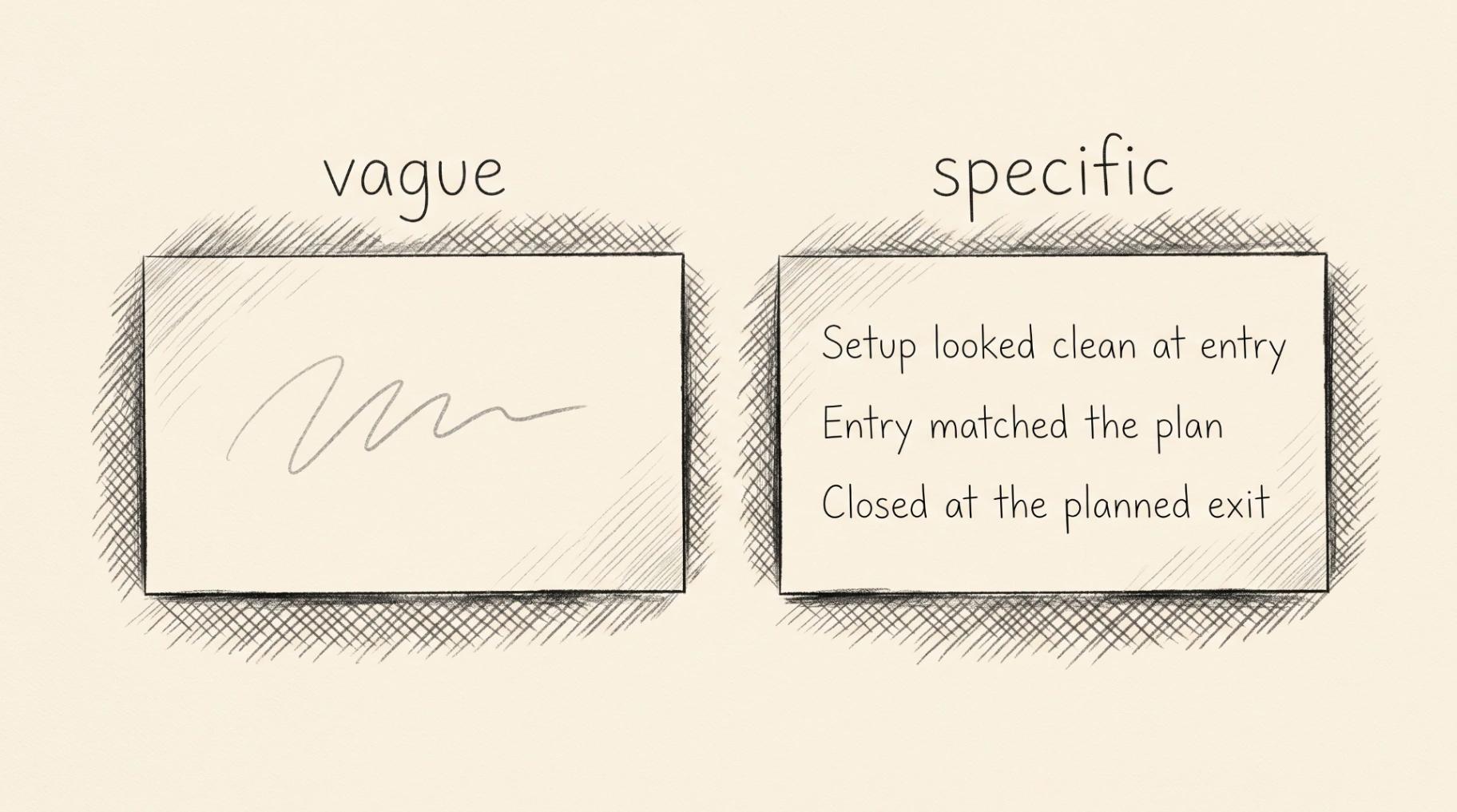
A journal entry that reads as some version of "did not work" or "market moved against me" is not really a record of anything. It is a placeholder that lets a trader feel like the log was kept up without actually capturing the one thing that matters, which is whether the decision itself held up against the plan that was in place at the time.
This overlaps closely with the same distortions covered in cognitive biases in trading, where memory of a trade quietly edits itself to feel more explicable than it actually was in the moment. A vague entry gives that editing process nothing to push against. A specific one, written in the terms that were actually available at the time of the decision, is the only thing that holds a memory accountable later.
The Three Lines That Actually Matter
A useful entry for a trade that did not work out does not need to be long. It needs three specific things, written in plain language, before the story has time to settle into something more comfortable.
First, what the setup actually looked like at the moment of entry, described the way it looked then, not the way it looks in hindsight now that the outcome is known. Second, whether the entry matched the written plan or deviated from it, and if it deviated, what the reason was at the time, not the reason that sounds better now. Third, what the actual result of the trade was structurally, where it was closed and why, separate entirely from any evaluation of whether that was a good or bad outcome.
That third point is the one traders skip most often, because the instinct is to fold judgment into the record itself instead of keeping the two separate. A trade that was closed exactly according to plan and still did not work out is a different entry than a trade that was closed off-plan under pressure, even if the two produced an identical result.
Grading the Decision, Not the Result
Once those three lines exist, the entry can actually be graded, and the grading has to happen against the plan, not against the outcome. A trade that followed the plan and still did not work out gets marked as a sound decision. A trade that happened to work out despite deviating from the plan gets marked as a decision that needs attention regardless of how it turned out.
This is the same distinction that trading confidence actually gets built on over time, and it only works if the grading happens consistently, on every entry, not selectively on the ones that are easy to be honest about. A log that only grades the trades that already feel comfortable to grade is not really tracking anything.
Writing It Down Before the Story Changes

The three-line version of the entry works best when it gets written within a few minutes of the trade closing, while the actual sequence of decisions is still available in memory rather than already smoothing itself into something more flattering. This does not need to be the full reflective entry. It can be rough, even messy, as long as it captures what actually happened before the account of it starts to drift.
A longer, more reflective pass, the kind that asks what could be done differently, works better later the same day or the next morning, once the immediate charge of the outcome has faded. Trying to do both at once, right after the trade closes, usually means the reflective part gets skipped entirely or gets written under the influence of whatever the trade just made someone feel, which tends to produce conclusions that do not hold up on a calmer read.
Where a Single Entry Becomes Something Useful

One entry on its own, however carefully written, does not show much. What starts to matter is what a stretch of entries looks like read together, whether the same kind of deviation keeps showing up, whether the trades marked as sound decisions cluster around a particular kind of setup, whether the ones marked as needing attention share something in common. That kind of reading only happens with structure behind it, the kind built into a proper weekly trading review, where a stretch of entries gets read as a set rather than one at a time as they happen.
This is also where trading psychology tools built around structured, dated logging earn their place, since the whole value of the three-line entry depends on it actually being there later, in a form that can be searched and compared rather than scattered across memory or half-remembered.
Keeping the Habit Through a Rough Stretch
The hardest stretch to keep this habit through is exactly the stretch where it matters most, a run of trades that did not work out, one after another. That is precisely when the instinct to skip the entry, or to write a rushed, vague version of it, gets strongest, because sitting with the detail of a decision that did not pay off is genuinely uncomfortable.
Treating the entry as a fixed part of closing any trade, written the same way regardless of how the trade turned out, is what keeps the log intact through the stretch where it would otherwise quietly stop being useful. This is the same kind of structural trading discipline that holds up a written plan in the first place, applied to the record of what actually happened rather than only to the decisions made in the moment.
FAQ
What should actually go into a losing trade's journal entry?
Three things: what the setup looked like at the time of entry, whether the entry matched the written plan and why if it did not, and what the actual result was structurally, kept separate from any judgment about whether the outcome was good or bad.
Why is "it did not work" not a useful entry?
Because it captures nothing about the decision itself. A vague entry gives the natural tendency to smooth over past decisions nothing to push against, while a specific one, written in the terms available at the time, holds the memory accountable later.
Should a losing trade be graded by its result?
No. Grading should happen against whether the decision matched the plan that was in place at the time, not against how the trade eventually turned out. A trade that followed the plan and still did not work out can still be marked as a sound decision.
When is the best time to write the entry?
A short, factual version works best within a few minutes of the trade closing, before memory starts to smooth the sequence of decisions into something more flattering. A longer reflective pass works better later the same day, once the immediate reaction has faded.
Why does journaling losing trades matter more during a rough stretch?
Because that is exactly when the habit is most likely to slip, and exactly when the detail in each entry is most useful. Treating the entry as a fixed part of closing any trade, regardless of outcome, is what keeps the record intact through the stretch where it matters most.