You Searched "Free Trading Journal." Here's What You're Actually Looking For
Almost every trader's journaling story starts the same way: a notebook, a spreadsheet, or a late-night search for "free trading journal." That instinct isn't laziness — it's logic. You don't know yet whether journaling will stick, so paying for software before proving out the habit feels backwards.
That logic is sound. What's less obvious is what "free" actually includes, what it quietly leaves out, and at what point the free version starts working against you instead of for you. This isn't an argument against free tools. It's a breakdown of what they're built for, what they're not, and which category you're in right now.
What a Free Trading Journal Actually Gives You
Most free trading journals — whether that's a dedicated app's free tier or a self-built sheet — cover the basics reasonably well. You can log a trade: symbol, direction, entry, exit, size, and a result. Many let you attach a screenshot of the chart. Some include simple tags so you can mark a trade as "breakout" or "revenge entry" after the fact.
For someone who has never journaled consistently before, this is genuinely useful. The hardest part of journaling isn't the analysis — it's the habit. A free tool that gets you logging trades every day is doing its job, and doing it well.
What Quietly Disappears in the Free Tier
The gap shows up once you ask the journal to do anything beyond storage. A few things that are almost universally missing, capped, or paywalled in free plans:
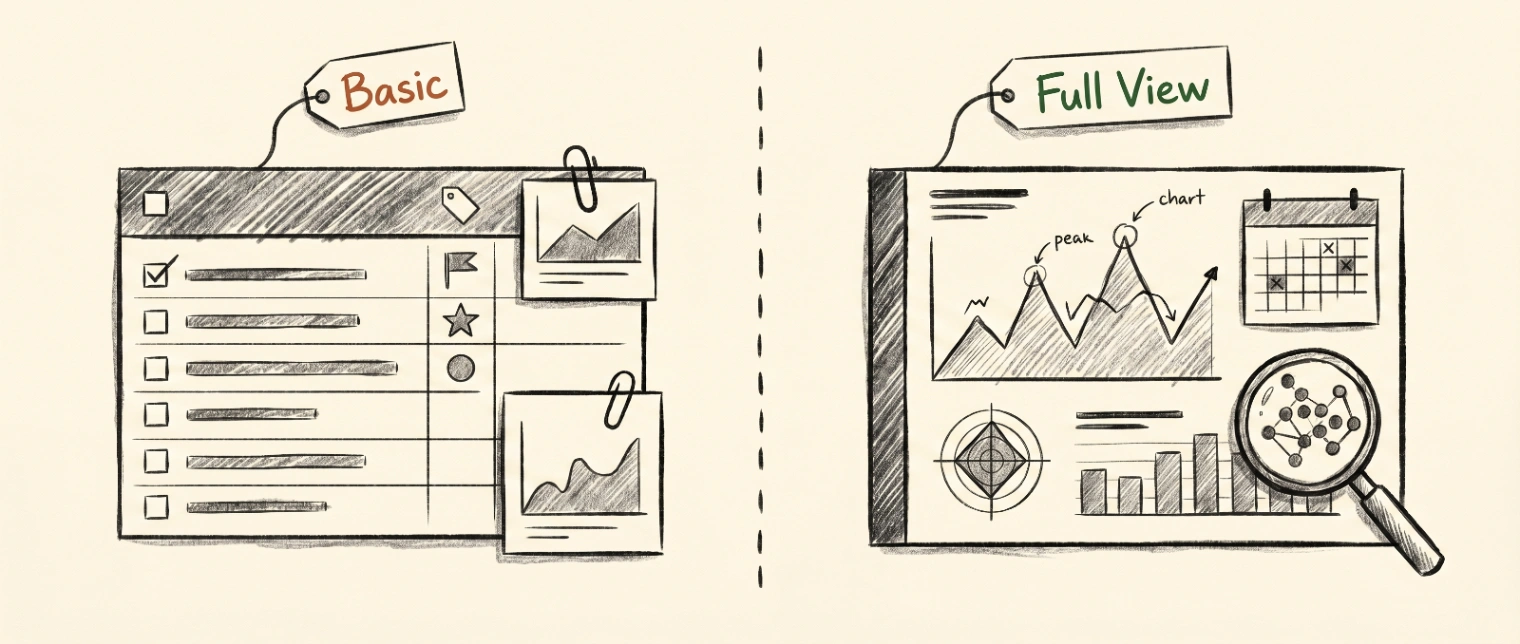
Broker auto-sync. Free tiers typically require manual entry or limit how many accounts and trades you can import automatically. At low volume this is a minor chore. At higher volume it becomes the main reason people quietly stop journaling.
Behavioral pattern detection. Tagging a trade as "FOMO" is easy. Noticing that 70% of your FOMO trades happen in the first 30 minutes after a loss is not something you'll spot by scrolling a spreadsheet — it requires the tool to actually analyze your history, which is where AI-generated insights come in, and where free tiers stop short.
MFE/MAE and R-multiple tracking. Knowing you lost $40 on a trade tells you the outcome. Knowing the trade was up 2R before it reversed tells you the story — and that distinction is almost always locked behind a paid tier or absent entirely.
Risk and correlation analytics. Things like drawdown curves, exposure across correlated pairs, or session-based performance breakdowns require enough underlying data structure that free tools rarely build them in.
Calendar and event context. Linking a losing week to a specific high-impact news event, or seeing your performance around earnings and macro releases, needs a layer most free journals don't offer.
None of this means free tools are "bad." It means they're built to answer "what happened," not "why does it keep happening."
When Free Is the Right Call
If you're an early-stage traders journey — testing a strategy on a small account, taking fewer than 10–15 trades a week, or still building a daily journaling habit — a free journal is not just acceptable, it's the right tool. The goal at this stage is consistency, not depth. Adding broker syncs, risk dashboards, and AI summaries to someone who hasn't yet logged 50 trades is solving a problem they don't have yet.
The same applies if you're paper trading or testing a brand-new strategy. You want low friction, not a feature-rich platform that takes longer to set up than it does to place the trade.
When Free Starts Costing You More Than It Saves
The shift usually happens quietly. You go from 5 trades a week to 20. You open a second account, maybe for a prop firm evaluation. You start noticing the same mistake repeating — but you can't prove it, because finding the pattern would mean manually re-reading weeks of entries.
This is the point where the "free" tool starts charging you in time instead of money. High-frequency traders feel this fastest — manual logging at volume isn't sustainable, and skipped entries quietly corrupt the dataset you're relying on to improve.
The honest signal to watch for isn't a feature list. It's this: are you still reviewing your trades, or have you started just logging them and moving on? If reviews have quietly stopped, the journal has become a filing cabinet, not a tool.
What to Look For, Whatever You Choose
A few questions worth answering before you pick (or stick with) a tool, free or paid:
How much manual entry will this realistically require at my current trade volume? If the honest answer is "more than I'll actually do," the journal won't get used regardless of its feature list.
Does it show me why, not just what? A log of outcomes is a record. A tool that surfaces patterns across those outcomes is feedback. They're not the same thing, and only one of them changes behavior.
Can I see this getting more useful as I grow, or will I hit a wall and have to migrate everything? Switching tools mid-strategy is its own kind of friction — the upgrade decision is easier when the free tier and the paid tier are the same product.
Where ChartWise Fits
ChartWise is built around the second half of that journey — the point where logging trades stops being enough and understanding why a pattern keeps repeating becomes the actual goal. The platform includes a 14-day free trial with no card required, so you can bring your existing trade history in, see what the behavioral and risk analytics actually surface, and decide for yourself whether it's solving a problem you have yet — or one you're about to have.
Either way, the habit comes first. The tool just needs to keep up once it forms.
FAQ
1. Is a free trading journal actually free, or are there hidden costs?
The software itself is usually free, but the cost shows up as time — manual entry, missing broker syncs, and the analysis you have to do yourself instead of the tool doing it for you.
2. What's the main difference between a free trading journal and a paid one?
Free tools focus on logging and storage. Paid tools typically add automated analysis — pattern detection, risk metrics, MFE/MAE, and broker integration — that turn raw entries into actionable feedback.
3. Can I just use a spreadsheet instead of a dedicated app?
Yes, and many traders start there. Spreadsheets work well at low volume but become harder to maintain as trade count grows, especially once you want to track behavioral patterns alongside the numbers.
4. How many trades can I log on a free trading journal?
This varies by tool, but free tiers commonly cap monthly trade imports or limit how many connected accounts you can sync — manual entry beyond that cap is usually still possible, just not automated.
5. Will a free trading journal sync with my broker automatically?
Often not, or only with limits. Automatic broker sync across multiple accounts is one of the most common features reserved for paid tiers.
6. How do I know when it's time to upgrade from a free trading journal?
The clearest signal is behavioral: if you've stopped reviewing your trades because logging them manually takes too long, the free tool has become a bottleneck rather than a help.
7. Does ChartWise offer a free trading journal option?
ChartWise offers a 14-day free trial with no card required, so you can test the full journaling and analytics experience before deciding if it fits your trading volume and goals.