Forex Trading Journal: Sessions, Pairs, and Finding Your Edge
Most forex traders know they should keep a journal. Most of them also know, if they are honest, that the one they have is not really working.
It might be a spreadsheet with columns for entry, exit, and result. It might be a generic journaling app originally built for stock traders. Either way, it captures the surface of what happened without getting anywhere near the patterns that actually explain performance.
The problem is not discipline. It is structure. Forex is a fundamentally different market from stocks, and a journal that was not built around its specific mechanics will always leave the most important questions unanswered.
This guide is about what those questions are, and what a forex trading journal needs to answer them.
Why Forex Is Not Like Any Other Market
Stock traders open their journal and log it simply: bought 200 shares of AAPL at $187, sold at $192. The currency is fixed, the session is fixed, the share size is straightforward. The journal works because the market is relatively uniform.
Forex is not uniform. It is three overlapping sessions with different personalities, dozens of currency pairs with different volatility profiles, pip values that shift depending on the pair and the lot size, and a market that never closes for five days straight. A trader who applies a stock-style journal to this environment will log their trades accurately and understand their performance almost not at all.
Here is what makes forex structurally different — and why each element needs to be in your journal:
Sessions. The forex market runs 24 hours, but it is not one continuous flow. The Asian session (00:00–09:00 GMT) tends toward tight ranges and lower volatility, with JPY and AUD pairs most active. The London session (07:00–16:00 GMT) brings the highest volume and the biggest moves, with EUR and GBP pairs dominant. The New York session (12:00–21:00 GMT) is USD-heavy, with significant volatility during the London-New York overlap. Most forex traders perform differently across these sessions and have no data to show it.
Currency pairs. EUR/USD and GBP/USD behave nothing like USD/JPY or exotic pairs. Each pair has its own volatility profile, spread cost, and relationship to macro events. Trading all pairs the same way is one of the most common sources of hidden losses. Most forex traders are profitable in two or three pairs and losing in the rest — and they rarely know which are which.
Pip values. A 50-pip move on EUR/USD is not the same as a 50-pip move on USD/JPY when you account for lot size and account currency. A journal that tracks only monetary result obscures the real performance picture. Pip-based tracking, normalised across pairs, is the only way to compare performance fairly.
Swap fees. Positions held overnight in forex accrue or are debited swap fees depending on the interest rate differential between the two currencies. For swing traders holding positions for days or weeks, these fees can silently erode results that look profitable on paper. If your journal does not capture swap costs, your performance data is incomplete.
What a Forex Journal Must Track
A properly structured forex trading journal captures everything a generic one misses. These are the fields that actually matter:
Currency pair. Not just "EUR/USD" — include a pair category tag (major, minor, exotic) so you can filter performance by pair type.
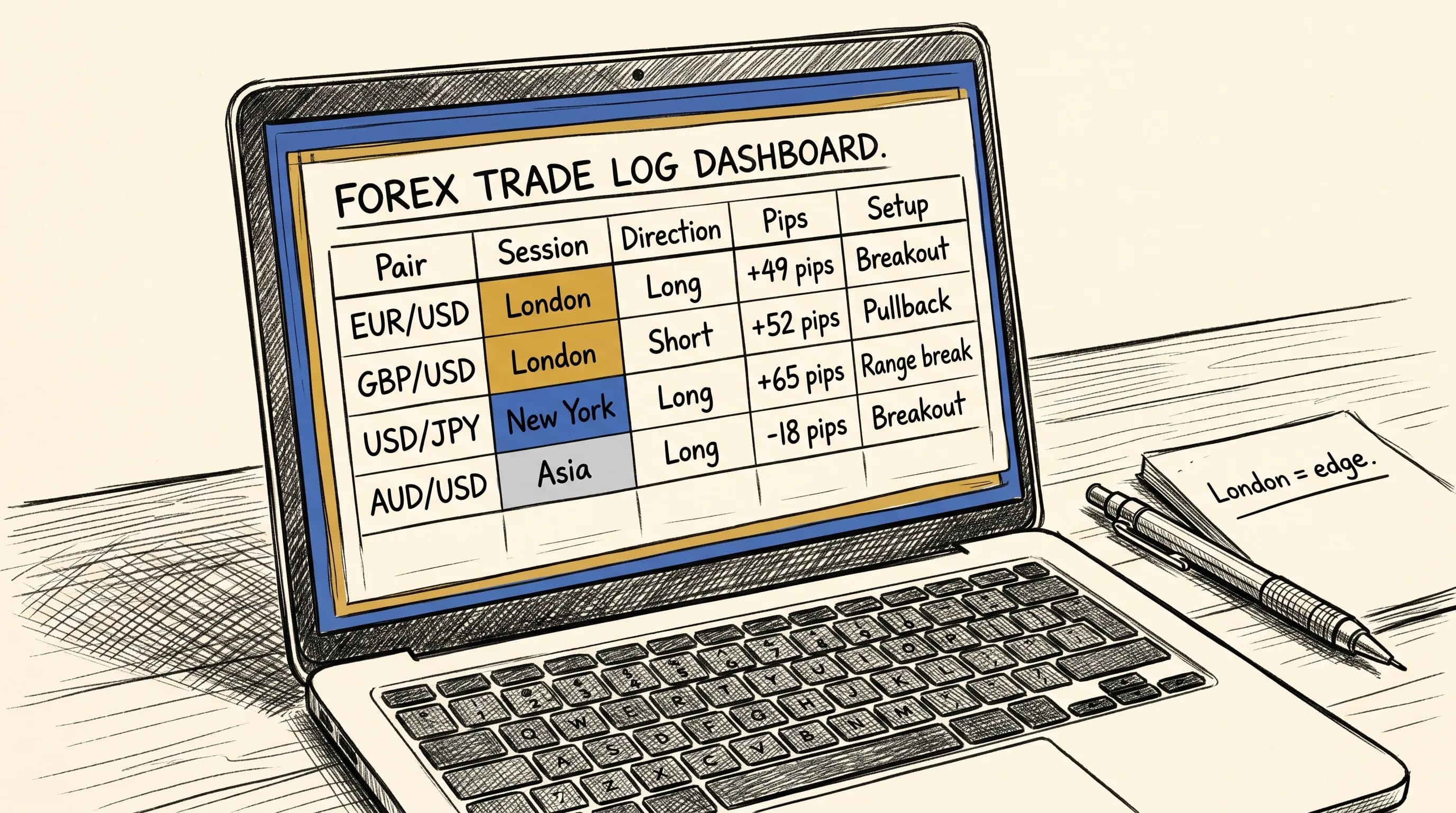
Session. Asian, London, New York, or overlap. This single field will reveal patterns most forex traders have never seen in their data.
Direction. Long or short. Forex traders often find they perform differently on long and short trades within the same pair.
Lot size. Exact position size in lots or units. This feeds your position sizing analysis and makes risk consistent across pairs — something your position sizing framework depends on having accurate data for.
Entry and exit price. In pips where possible, not just monetary value.
Pips gained or lost. Normalised pip result, separate from monetary result, for fair cross-pair comparison.
Spread at entry. The spread you paid when you entered. Wider spreads on exotic pairs can make a setup that looks good on a chart unprofitable in practice.
Swap fee (if applicable). For any position held overnight. Critical for swing traders.
Setup tag. Breakout, pullback, range play, news trade, session open. One or two words that let you filter performance by strategy type.
Macro context tag. Was there a major news event? Central bank decision? NFP? These events behave differently across pairs, and tagging them lets you filter out or focus on high-impact data later.
Session Analysis: The Most Valuable Forex Insight
Once you have a few weeks of session-tagged trades, the analysis becomes immediately useful.
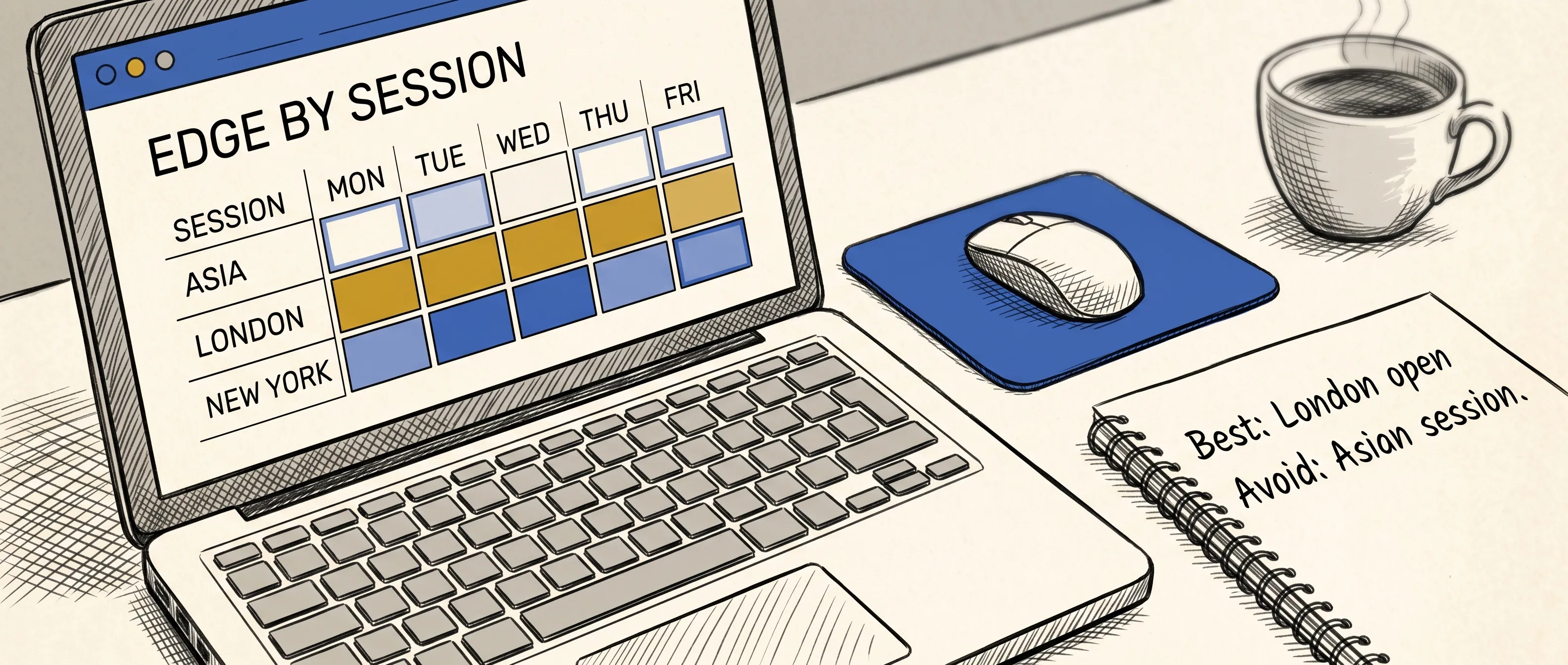
Most forex traders will discover that their performance is not consistent across sessions. They might find that their London session trades have a reliable edge but their Asian session trades are a slow bleed. Or that they take their best setups during the London-New York overlap and their worst setups in the dead hours of the Asian session when they are bored and looking for something to do.
None of this is visible in an untagged trade list. It only emerges when you can slice your data by session — and once you see it, the action is obvious. Stop trading the sessions where your data says you have no edge. Protect the sessions where you do.
This kind of analysis is one of the highest-leverage things a forex trader can do. It does not require better setups or a new strategy. It requires the data to answer a simple question: when do I actually trade well?
Currency Pair Analysis: Finding Where Your Edge Lives
The second most valuable thing your forex journal can show you is pair-specific performance.
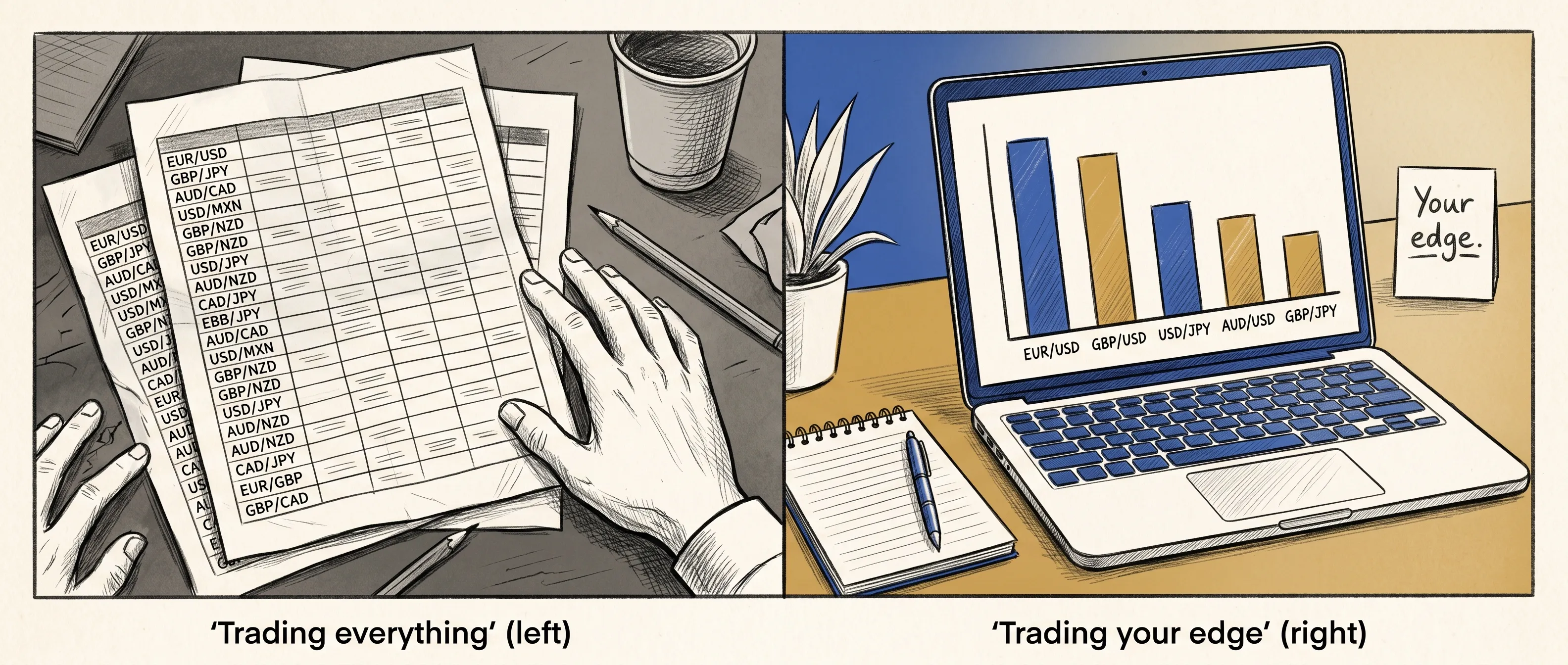
Most forex traders trade too many pairs, often out of boredom or the belief that more markets means more opportunity. The data almost always tells a different story. Profitable traders tend to have a genuine edge in a small number of pairs — usually two or three — and their results in other pairs are neutral at best and loss-making at worst.
Your journal can show you this directly, if you have the pair field and enough trade history. Filter by pair, look at your pip performance and your risk-to-reward ratio across each one, and compare. The pairs where your edge is real will look clearly different from the pairs where it is not.
The follow-through action is not glamorous but it is effective: stop trading the pairs where you have no edge, and increase focus on the pairs where you do. A trader who takes 40 trades per month across 8 pairs and discovers that 35 of their profitable trades came from 2 pairs has just found their edge — and the appropriate response is to concentrate on it.
The Pip vs Dollar Problem
One of the reasons forex performance is so difficult to assess intuitively is that monetary results vary with position size, pair, and account currency in ways that are not immediately obvious.
A trader who made $200 on one trade and lost $150 on another might think they are slightly ahead. But if the winning trade was a 5-pip move on a large lot and the losing trade was a 50-pip stop out on a small lot, the picture looks very different in pip terms. The trader might be losing on their setup and only staying above water because of sizing decisions.
Pip-normalised tracking removes this distortion. When you log pips gained and lost across trades — independent of lot size — you can see your actual setup performance rather than the result of a mix of setup quality and position sizing decisions. This makes it much easier to find what is actually working and what is not. The trading journal software you use should support pip-based tracking natively, not just monetary result.
Reviewing a Forex Journal: Different Rhythms for Different Timeframes
The review cadence for a forex journal depends on your trading style. A day trader in forex needs a daily end-of-session review. A swing trader holding positions for days might review every two or three days, with a deeper weekly review on the weekend.
Whatever the frequency, the structure of the review stays the same: did you follow your plan, were there any deviations, and what is one thing to carry forward.
The deeper reviews — weekly and monthly — are where forex-specific patterns emerge. A weekly review might reveal that you only took losing trades on Fridays when liquidity was thin. A monthly review might show that you perform better in trending market conditions than in ranging ones, or that your results decay significantly during major news weeks when pairs become unpredictable.
Trading consistency in forex is built on this kind of structured review. Not perfection on every trade — but a pattern of learning that compounds over time.
The Behavioural Side of Forex Trading
Forex has some specific psychological traps that are worth tracking explicitly in your journal.
Session creep. The 24-hour market means there is always something open. Traders who have no edge in the Asian session but trade it anyway out of habit or boredom accumulate losses they do not need to take.
Pair hopping. Moving between pairs after a losing streak, looking for a winner somewhere else in the market. This tends to spread losses across more pairs rather than fixing the underlying problem.
News gambling. Taking large positions ahead of high-impact events like NFP or central bank decisions without a clear framework for doing so. The results are volatile and often negative.
Swap blindness. Holding positions longer than intended because they are in profit, without accounting for the swap costs that are accumulating against that position.
When your journal captures session, pair, macro context, and swap fees, these patterns become visible. You can see session creep in your data. You can see pair hopping as a cluster of losses across multiple instruments in a short period. Behavioral trading analysis applied to your forex data does not just show you what you traded — it shows you how you behaved under pressure.
How AI Changes the Forex Journal
The forex-specific insights described above — session performance, pair analysis, pip normalisation, behavioural pattern detection — are all possible in theory with a manual spreadsheet. In practice, very few traders do the analysis because it requires hours of work on top of an already demanding trading day.
AI changes this by doing the analysis automatically, in the background, on every trade you take.
When an AI system has access to your complete forex trade history — tagged by session, pair, direction, and setup — it can surface the patterns that would take a human analyst hours to find. It can tell you that you are systematically losing pips on Asian session breakout trades but winning on the same setup during the London open. It can flag that your GBP/USD performance has deteriorated over the past three weeks in a way that matches a change in your position sizing. It can identify that your worst days all follow a similar pattern: a losing trade in the first hour, followed by two revenge trades.
This is not prediction. It is pattern recognition applied to your own decision history. For forex traders specifically, where the complexity of the market creates more variables than any human can track manually, this kind of AI-assisted analysis is the difference between logging trades and actually learning from them.
A Note on Forex Journal Formats
The best format for a forex trading journal is one you will actually use consistently. For some traders that is a dedicated software platform. For others it starts as a spreadsheet and evolves from there.
What matters more than the format is the fields. If your journal does not capture session, pair, pip result, and setup tag as a minimum, it will not give you the forex-specific insights that move the needle. Everything else is secondary to having the right data in the first place.
If you are reassessing your current setup, start by asking whether your journal can answer these questions from your existing trade history: Which session am I most profitable in? Which pairs drive my results? What is my pip performance by setup type? If the answer to any of these is "I don't know," the journal is not working for you.
A forex journal built around these metrics — and supported by AI that surfaces patterns automatically — is one of the most direct paths to understanding where your edge actually lives, rather than where you think it does.
ChartWise is an AI trading journal built for active traders. It auto-imports your trades the moment they close, supports session and pair-level analysis, and surfaces behavioural patterns through an AI that knows your full trade history. Early access is open — join the waitlist at chartwise.app.
FAQ
What should a forex trading journal include?
A forex trading journal should include currency pair, session (Asian, London, New York), direction, lot size, entry and exit price, pip result, spread at entry, swap fee if held overnight, setup tag, and macro context tag. These fields give you the forex-specific data needed for session analysis, pair performance tracking, and behavioural pattern detection.
Why is a forex journal different from a stock trading journal?
Forex has unique structural features that stock journals are not designed to capture — three distinct trading sessions with different behaviour, pip values that vary by pair and lot size, spread costs, overnight swap fees, and a 24-hour market. A forex-specific journal tracks these elements so your performance data reflects the real complexity of the market.
How do I track session performance in a forex journal?
Tag every trade with the session it was taken in — Asian, London, New York, or the London-New York overlap. After several weeks of data, filter your trade history by session and compare pip performance, win rate, and risk-reward across each one. The sessions where you consistently underperform are the ones to reduce or eliminate.
What is pip tracking and why does it matter?
Pip tracking records the number of pips gained or lost on each trade, separate from monetary result. Because pip values differ across pairs and lot sizes, monetary result alone can distort your performance picture. Pip-normalised tracking lets you compare setup quality fairly across all pairs regardless of position size.
How often should I review a forex trading journal?
Day traders in forex should do a brief end-of-session review daily. Swing traders can review every two to three days with a deeper weekly session. Monthly reviews reveal longer-term patterns — like macro event performance, session drift, or pair-specific trends — that do not show up in shorter review windows.
Can AI help with a forex trading journal?
Yes, significantly. AI can surface session performance, pair-level analysis, pip trends, and behavioural patterns automatically without requiring hours of manual analysis. For forex traders who generate complex, multi-variable trade data across pairs and sessions, AI converts raw logs into structured, actionable insight far faster than manual review.