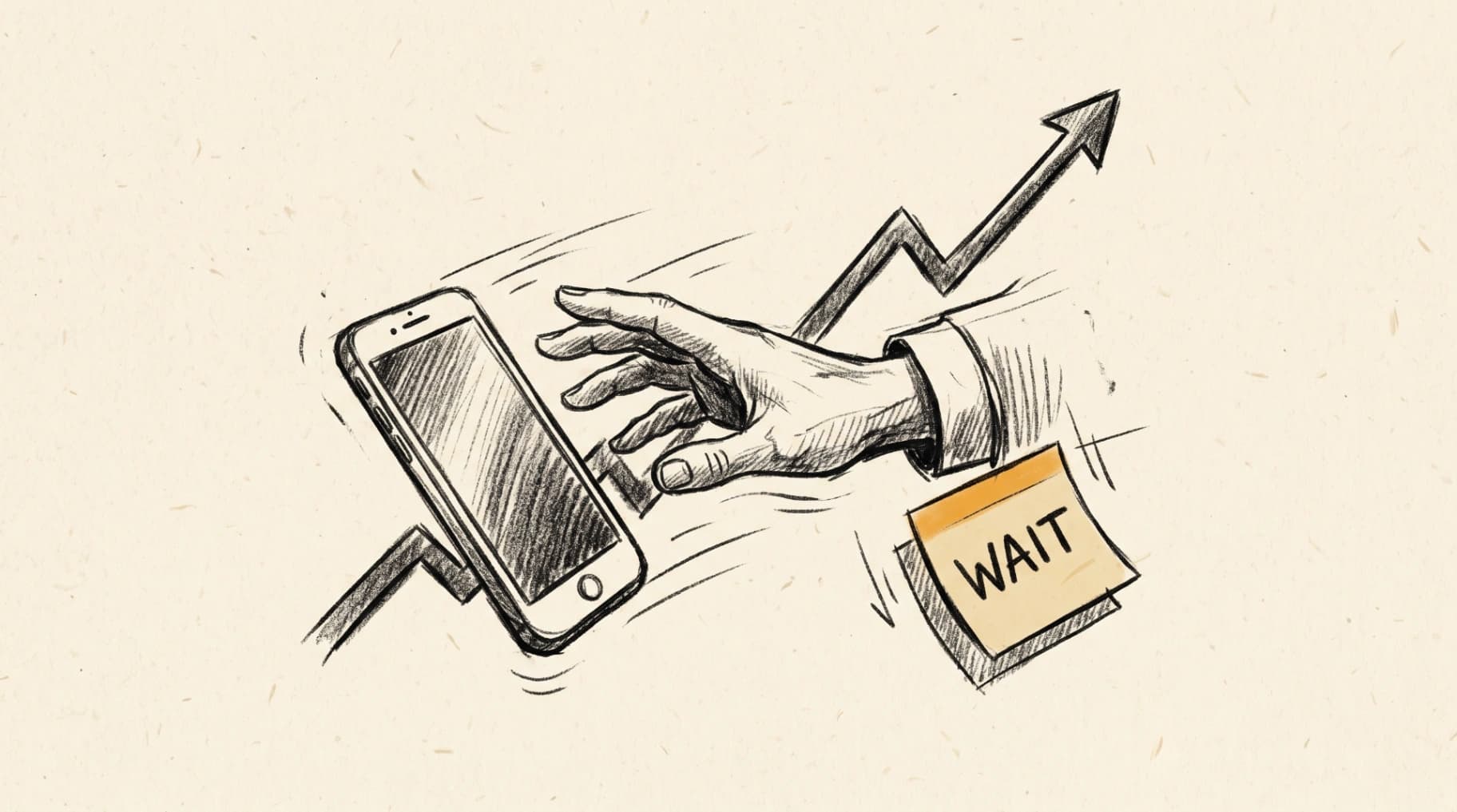
FOMO does not arrive as a thought. It arrives as a feeling in the chest, a sense that the market is leaving without you, and by the time you notice it, your finger is already near the buy button.
What FOMO trading actually looks like
Fear of missing out shows up in a handful of repeatable moments. A stock rips higher without you in it. A setup you skipped starts working exactly the way you predicted. A group chat lights up with screenshots of other people's positions. In each case, the trigger is not analysis. It is the discomfort of being on the outside of a move that is already underway.
The trade that follows usually breaks two or three rules at once: entry after the move has already extended, size larger than planned because "this one is different," and a stop that gets set loosely or not at all because pausing to think feels like losing more ground.
Why the brain chases motion
Humans are wired to notice what moves and to want to be part of it. That instinct helped when the moving thing was a herd or a threat. In markets, it does the opposite of what a trader needs. A candle already extended is not an opportunity, it is information that the easy part of the move is behind you. But the brain does not read it that way in the moment. It reads speed as safety, because fast-moving things look like consensus, and consensus feels safe.
This is part of a wider set of cognitive shortcuts that quietly distort trading decisions, and FOMO is one of the loudest of them.
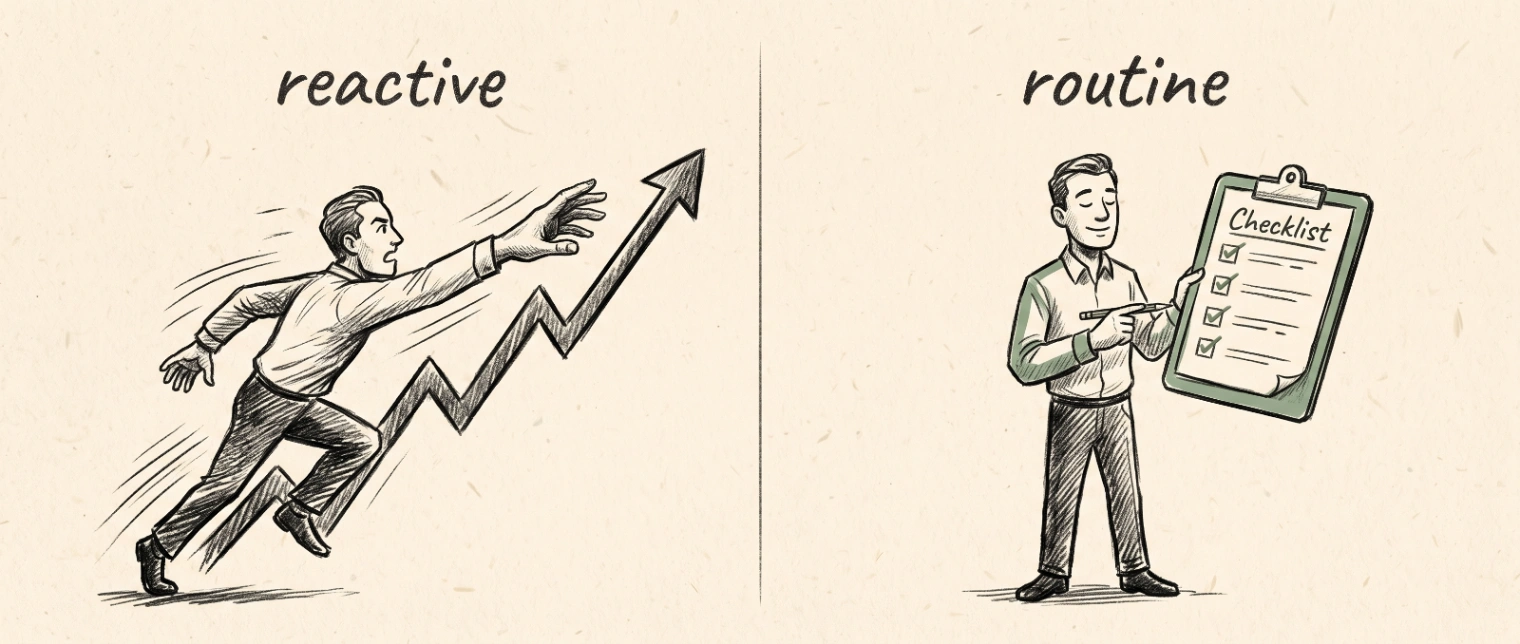
The three moments FOMO takes over
The first is the missed setup. You had the level marked, you hesitated, and the market moved without you. The instinct is to jump in anywhere just to feel back in the game.
The second is the group signal. Someone else's win gets shared in real time, and the urge to replicate it overrides your own plan, even when you have none of their context.
The third is the recovery chase. After a rough stretch, one green trade feels like proof the tide is turning, and the temptation is to size up immediately to make up ground faster.
All three share the same root: the decision is being made to resolve a feeling, not to satisfy a setup.
What this costs you beyond the single trade
The direct damage of a FOMO entry is usually visible fast: a worse price, a wider stop, a position that fights you from the first candle. The quieter damage is what it does to your process. Every FOMO trade that works out teaches your brain that the shortcut is safe, which makes the next one easier to justify. Every one that does not work out gets logged, if it gets logged at all, as bad luck rather than a pattern worth reviewing.
Over weeks, this compounds into a journal full of trades that were never really planned, which makes it nearly impossible to tell your edge apart from your impulses.
How to catch it before you click
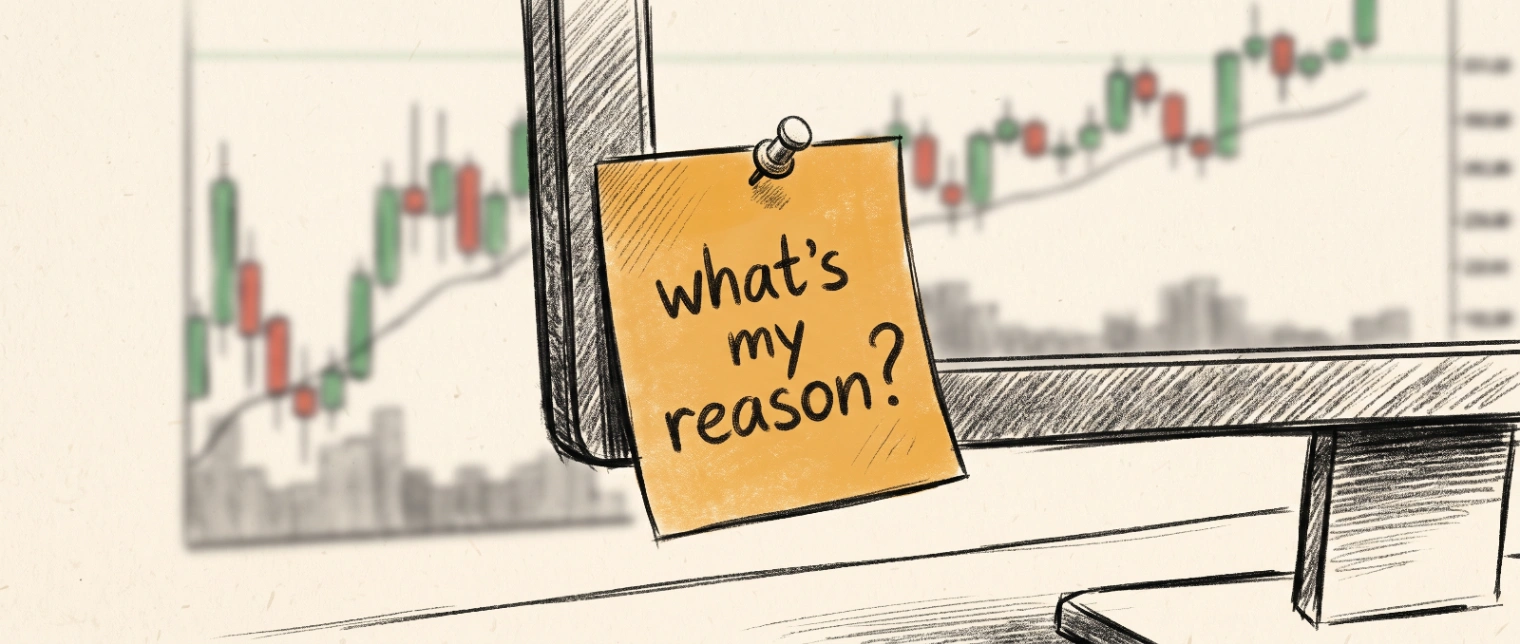
The single most useful habit is a pause with a name. Before entering anything that was not on your watchlist an hour ago, ask one question out loud or in writing: what is my reason for this entry that is not "everyone else is in it"?
If the honest answer references a chart pattern, a level, or a plan you wrote earlier, proceed. If the honest answer references a feeling of being left behind, that is the signal to stand down, not to speed up.
Building a FOMO checkpoint into your routine
A checkpoint only works if it survives contact with an actual fast market, which means it has to be built in before you need it, not invented in the moment. A few ways traders make this stick:
A written pre-trade line. One sentence, entered before every trade, stating the setup in plain language. If you cannot write the sentence in under ten seconds, you likely do not have a setup yet.
A size cap for anything outside the plan. Any position entered without a pre-existing plan gets automatically capped at a fraction of normal size, which removes the temptation to go big to catch up.
A cooldown after a missed move. A short, fixed pause, even five minutes, between watching a missed setup and taking any new position.
A weekly tally of impulse entries. Counting how many trades this week had no prior plan is often more revealing than looking at outcomes alone.
None of these remove the feeling of FOMO. They just make sure the feeling has to pass through a step before it becomes a position, and that single extra step is usually enough to break the pattern. Pairing this with consistent trading psychology tools and a broader look at trading discipline turns this from a one-off fix into a repeatable habit.
FOMO and its close relative, revenge trading, tend to show up together, one after the other, because both are driven by the same discomfort with sitting still. Recognizing one makes the other easier to catch too.
FAQ
Is FOMO trading the same as overtrading?
They overlap but are not identical. Overtrading is about frequency, taking too many trades in a short window. FOMO trading is about the trigger behind a specific entry, the fear of being left out of a move. A single FOMO trade can happen even on an otherwise quiet day.
Can a stop fix a FOMO entry?
A stop limits how far a bad entry can go against you, but it does not fix the entry itself. The goal is to reduce how often FOMO entries happen in the first place, not just to manage them better once they occur.
Does FOMO get better with experience?
It gets more recognizable with experience, which is not quite the same as disappearing. Most experienced traders describe still feeling the urge, they just have a checkpoint that catches it before it turns into an order.
What is the fastest way to spot a FOMO trade in my own history?
Look for entries with no prior plan, price already extended before entry, and size larger than your average. When two or more of these line up on the same trade, FOMO was likely the real trigger, whatever the chart pattern looks like on the surface.