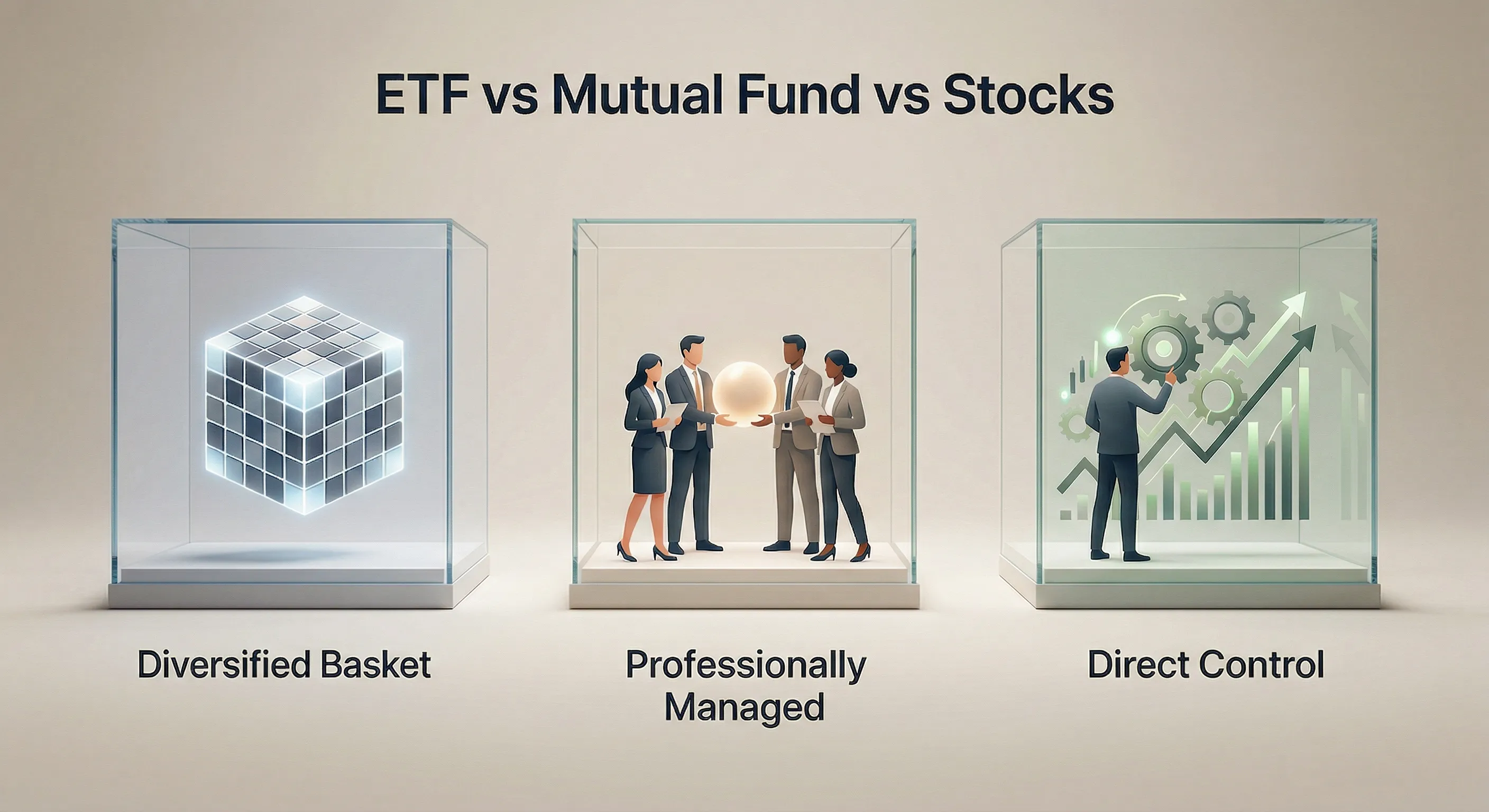
ETF vs Mutual Fund vs Stocks: How to Choose the Right Investment Strategy
When it comes to investing, the biggest confusion isn’t what to invest in.
It’s how to invest in it.
If you're trying to decide between ETF vs mutual fund vs stocks, the choice depends on how much control, effort, and involvement you want in your investing strategy.
All three give you access to the market. But they differ in cost, flexibility, risk, and how actively you need to participate.
ETF vs Mutual Fund vs Stocks: What’s the Real Difference?
Which is better: ETF, mutual fund, or stocks?
There is no single best option.
ETFs are better for passive investing and low-cost diversification
Mutual funds are better for professionally managed portfolios
Stocks are better for investors who want full control and higher return potential
The right choice depends on your goals, risk tolerance, and how actively you want to manage your investments.
What Are ETFs?
Exchange-Traded Funds (ETFs) are investment funds that trade on stock exchanges, just like individual stocks.
They usually track an index, sector, or asset class, allowing you to invest in a basket of securities through a single purchase.
Key Advantages of ETFs
Low cost compared to mutual funds
Easy to buy and sell like stocks
Instant diversification
Transparent holdings
Limitations of ETFs
No active management
Returns are tied to the market
Requires a demat/trading account
What Are Mutual Funds?
Mutual funds pool money from investors and are managed by professional fund managers.
Instead of making decisions yourself, the fund manager decides where to invest based on the fund’s objective.
Key Advantages of Mutual Funds
Professionally managed
Suitable for beginners
SIP (Systematic Investment Plan) option
Less need for active monitoring
Limitations of Mutual Funds
Higher fees than ETFs
Less control over investments
NAV-based pricing (not real-time trading)
What Are Stocks?
Stocks represent ownership in a company. When you buy a stock, you are directly investing in that company’s growth.
Key Advantages of Stocks
Full control over buying and selling decisions
Potential for higher returns
No management fees
Flexibility in strategy
Limitations of Stocks
Higher risk
Requires research and time
Emotional decision-making can impact performance
ETF vs Mutual Fund vs Stocks: Key Differences
ETFs
Passive management
Low cost
Medium control
Moderate risk
High liquidity
Mutual Funds
Actively managed
Medium to high cost
Low control
Moderate risk
Medium liquidity
Stocks
Self-managed
Low cost
High control
High risk
High liquidity
How to Choose the Right Investment Strategy
Choosing between ETFs, mutual funds, and stocks depends on three things:
1. Your Experience Level
Beginners often prefer mutual funds
Intermediate investors lean toward ETFs
Advanced traders prefer stocks
2. Time Commitment
Low time → Mutual funds
Medium time → ETFs
High time → Stocks
3. Risk Tolerance
Low risk → Mutual funds / ETFs
High risk → Stocks

Beginner Portfolio Strategy
A balanced approach often works best:
40% in ETFs for diversification
30% in mutual funds for stability
30% in stocks for growth
This kind of allocation works well as a simple investment strategy for beginners who want both stability and growth.
Passive vs Active Investing
Choosing between passive and active investing is really about how much control you want over your decisions.

Passive investing focuses on tracking the market over time. It is simple, consistent, and requires minimal intervention.
Active investing focuses on outperforming the market through decisions. It requires time, effort, and the ability to manage risk actively.
Key Difference
Passive: Market tracking, simplicity, consistency
Active: Decision-driven, higher effort, higher control
Neither approach is better. The right choice depends on your time, skill, and involvement.
The Real Problem Isn’t the Investment — It’s the Decisions
Most investors don’t lose money because they chose the wrong asset.
They lose because:
They exit too early
They hold losing positions too long
They change strategy mid-way
Most tools show outcomes. Very few help you understand decisions.
ChartWise is designed to solve exactly this problem.
If you're actively investing in stocks, tracking your trades and reviewing your performance can significantly improve your decision-making over time.
Conclusion
There’s no universal winner between ETFs, mutual funds, and stocks.
Each serves a different purpose:
ETFs for simplicity
Mutual funds for guidance
Stocks for control
The smartest investors don’t choose one.
They choose what fits their strategy.
Because in the end, investing isn’t about picking the perfect asset.
It’s about consistently making better decisions.