Day Trading Journal: How High-Volume Traders Actually Use One
There is a version of the trading journal story that most people have lived through.
You decide you are finally going to be disciplined about it. You open a spreadsheet, label the columns, and log your trades from today's session. Entry, exit, size, notes. You do it Monday. Maybe Tuesday. By Wednesday you take nine trades before 10am and the last thing you want to do at 3pm is fill in a spreadsheet. So you tell yourself you will catch up tomorrow.
You do not catch up tomorrow.
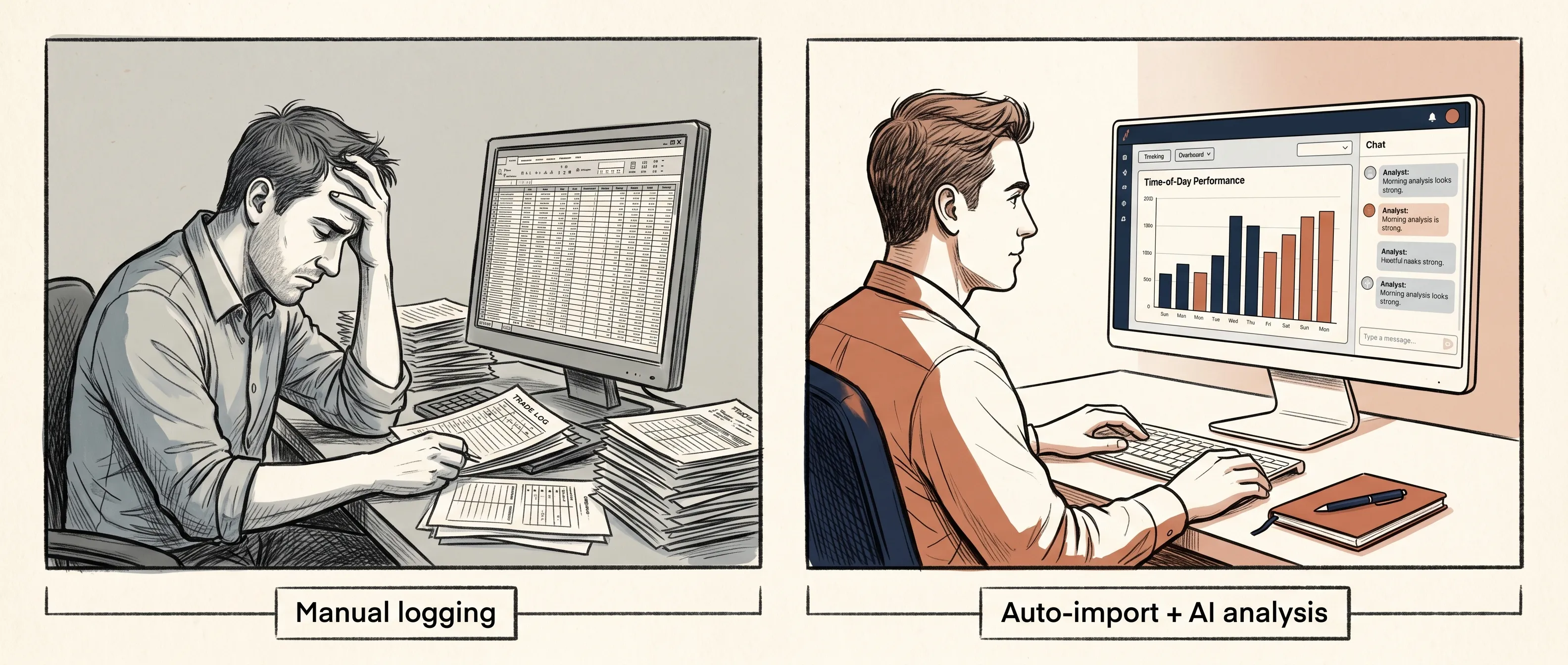
This is not a discipline problem. It is a design problem. Standard journaling systems were not built for the pace of day trading. When you are taking 3 to 15 trades per session, the friction of manual entry does not scale. The journal becomes a burden, and burdens get abandoned.
The question is not whether you should keep a day trading journal. The question is what kind of journal actually survives contact with your real trading day.
Why Day Trading Is Different From Any Other Style
Swing traders and position traders have time. A swing trader might take two to four trades in a week. They can sit down, reflect on each one, write paragraphs, attach charts, and think about what went right or wrong. That kind of journaling is sustainable because the volume is low.
Day traders do not have that luxury. Volume is the defining feature of the style. You might take three trades before the London open and another six before the New York session closes. Each trade happens quickly. Decisions are made in seconds or minutes, not hours. By the time the session is over, the details of your first trade are already getting fuzzy.
This is the core tension: the traders who need journaling most are the ones for whom standard journaling is least practical.
What a day trading journal actually needs is not a longer template. It needs speed, precision, and the ability to surface patterns across hundreds of trades automatically — because no human can see those patterns by reviewing rows in a spreadsheet. If you are still deciding between options, this guide to trading journal software breaks down what to look for.
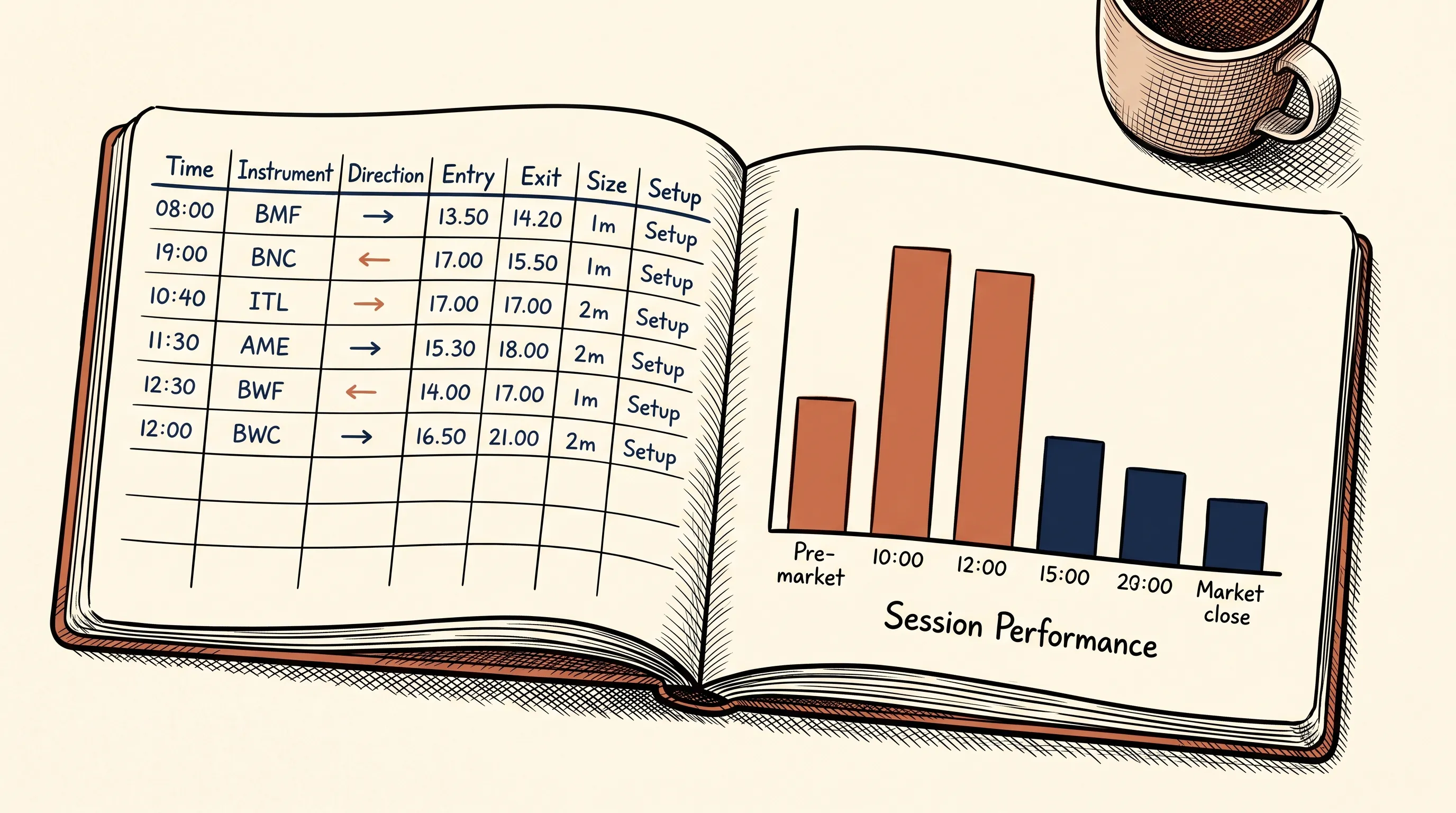
The 7 Things That Actually Matter to Track
Not everything needs a field in your journal. Day traders who try to capture everything end up capturing nothing. The goal is to log what is diagnostic — the data that will actually change your behaviour when you look back at it.
1. Time of entry This is the single most underused data point in day trading journals. Most traders have two or three profitable hours in the day and do not know it. Once you can see your performance mapped by hour, you can protect those hours and question everything you do outside them. A good trading performance tracker makes this kind of time-based analysis automatic.
2. Instrument and direction Long or short, and on what. Simple, but essential for filtering your data later. Do you perform differently on long trades versus short? Are you better in one instrument than another? You cannot know without the field.
3. Entry and exit price Not just the result — the actual prices. This feeds your MFE (Maximum Favourable Excursion) and MAE (Maximum Adverse Excursion) data, which tells you how much room a trade actually had versus how much you gave it. If you keep getting stopped out before the move happens, that shows up here.
4. Position size Sizing inconsistency is one of the most common hidden problems in day trading. Traders often size up on gut feel after a few wins and size down after losses. Over hundreds of trades, this creates a distorted picture of actual edge.
5. Setup tag A one or two word label for what the trade was: breakout, pullback, reversal, range fade. This lets you filter performance by setup type. You might find your breakout trades are profitable but your reversal trades are bleeding you.
6. Session or market condition London open, New York session, overlap, pre-market. Market behaviour changes across the day. Knowing which conditions favour your strategy is more useful than knowing your overall win rate.
7. Exit reason Did you exit at your planned target? Stop hit? Early exit? Scaled out? The gap between your planned exit and your actual exit is where most of day trading's performance problems live.
These seven fields give you everything you need without demanding thirty minutes of logging after a draining session.
The Problem With Manual Entry at Volume
Here is what happens when a day trader commits to a manual journal in good faith.
Monday is fine. The session goes well, you log everything, the habit feels solid.
Tuesday you take twelve trades. The market is moving fast, you are in and out of positions, and some of your notes are already incomplete by the time you try to fill them in. You spend twenty minutes on the journal and still feel like something is missing.
Thursday you are mentally exhausted after a tough session. The last thing you want to do is open the spreadsheet. You skip it.
By the following Monday, the gap feels too large to close. The journal gets quietly abandoned.
This is not a failure of willpower. It is what happens when you ask a high-volume trader to add a significant administrative task to the end of every session. The cognitive load is too high.
The solution is not to simplify the template. The solution is to remove the manual entry step entirely.
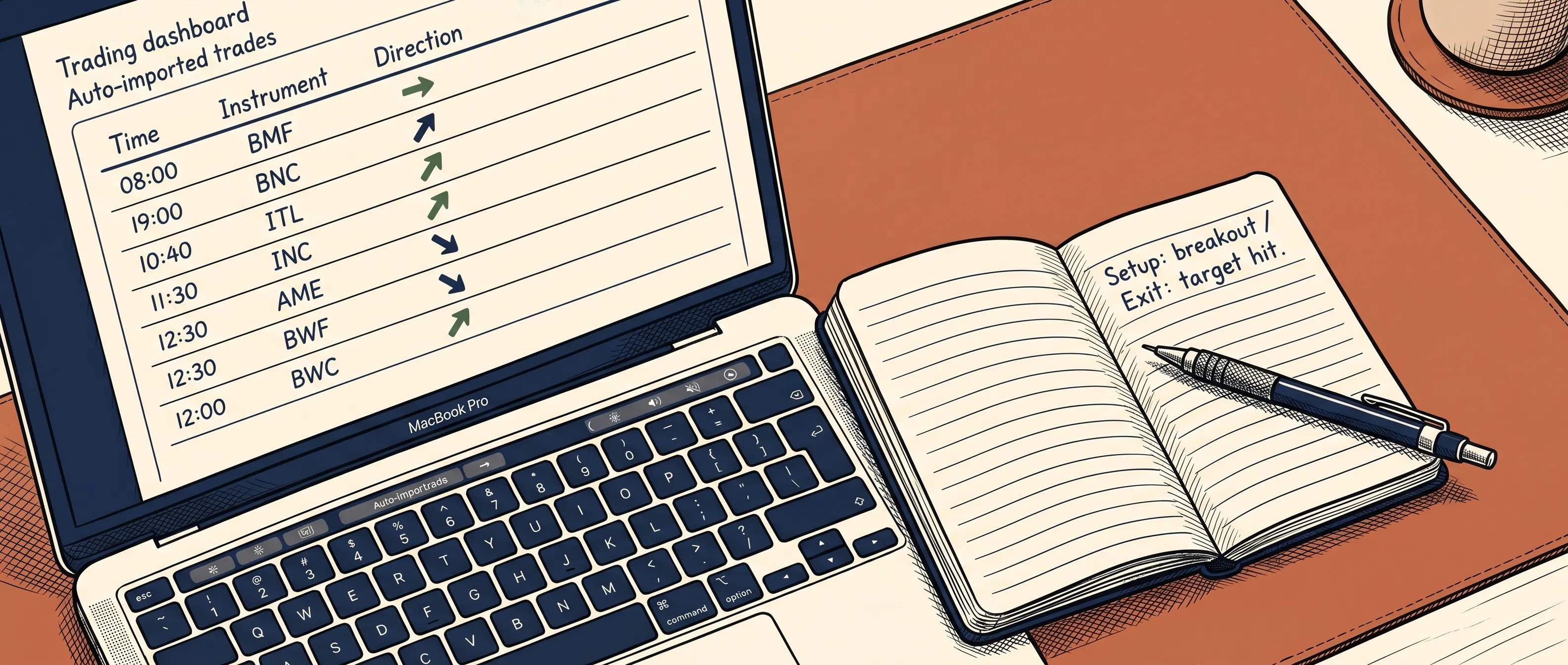
When your journal auto-imports every trade the moment it closes — including price, size, time, and instrument — the logging problem disappears. You do not have to remember anything. The data is already there. The only thing left for you to do is add the setup tag and exit reason, which takes seconds rather than minutes.
This changes journaling from a task into a tool. And tools get used.
What Time-of-Day Analytics Actually Reveals
Once you have a few weeks of trades logged — especially if they are imported automatically — time-of-day analysis becomes one of the most powerful things you can do with your data.
Most day traders are profitable in certain hours and losing in others. They know this intuitively but cannot quantify it. When you can filter your entire trade history by hour of entry, patterns that were invisible become obvious.
You might discover that your trades entered in the first hour of the New York open have a dramatically different outcome profile than your trades entered in the late afternoon. You might find that your best setups only appear during the London and New York overlap. You might realise that Friday afternoon trading is quietly destroying three weeks of gains.
None of this is visible in a raw list of trades. It only emerges when you can slice the data by time. And once you see it, you can act on it — by protecting your best hours, questioning your worst, and building a session structure that matches where your actual edge lives.
Session Reviews: The End-of-Day Ritual That Actually Works
The end-of-day review is where a day trading journal earns its value. Not during the session — trying to reflect in real time is a distraction. After. If you want a structured framework for this, the trade review process guide walks through exactly how to do it efficiently.
A focused ten-minute session review is more useful than thirty minutes of unfocused reflection. The goal is not to write an essay. It is to answer three questions:
Did I follow my plan? Not whether you made money — whether the trades you took were the ones you said you would take. This separates execution quality from market outcome.
Were there any deviation points? A trade where you sized up for no clear reason. An exit that came before your target because of a feeling. A revenge trade after a loss. These deviation points are where your edge erodes. Naming them is the first step to catching them earlier next time. If revenge trading or overtrading is a recurring pattern, your journal data will confirm it within weeks.
What is one thing to carry into tomorrow? Not a list of ten things. One. The constraint forces prioritisation and makes it actionable.
When your journal is connected to analytics that flag emotional patterns — like increased trade frequency after a losing streak, or tightened stops after a drawdown — the review becomes a conversation between your intentions and your actual behaviour. That feedback loop is what turns a trading journal into a genuine development tool. For a deeper look at how this works, behavioral trading analysis covers the patterns that show up most consistently across trader data.
How AI Changes the Day Trading Journal
The journal model that most traders know — log trade, add notes, review manually — was built for a time when that was the only option. AI does not just make that process faster. It changes what is possible.
When an AI system has access to your full trade history, it can surface patterns that would take a human analyst hours to find. It can tell you that your average hold time drops significantly when you trade during high-volatility conditions. It can identify that your worst losing days share a specific structural pattern in how the session started. It can flag when your current behaviour is diverging from your baseline.
This is not algorithmic trading. It is pattern recognition applied to your own decision-making — a kind of mirror that shows you how you actually trade, not how you think you trade.
For day traders specifically, this matters more than it does for any other style. The volume of decisions you make in a week creates a data set large enough for meaningful analysis. The challenge was always capturing that data without drowning in manual entry. When auto-import handles the capture and AI handles the analysis, the only thing you have to do is act on what it shows you.
This is what a modern day trading journal looks like — not a spreadsheet you fill in, but a system that reads your trading and talks back.
Day Trading Journal vs. Daily Trading Journal: A Quick Distinction
These two terms are often used interchangeably, but they describe different things.
A daily trading journal refers to the habit — journaling every day, regardless of style. You might be a swing trader who does end-of-day reviews every evening even on days you did not trade.
A day trading journal refers to the structure — a journal built specifically for intraday traders who take multiple trades per session and need tools designed for that volume and pace.
If you are a day trader keeping a daily journal, you need both: the consistency of the daily habit and a format that does not collapse under the weight of your trade volume.
The Real Reason Most Day Traders Quit Journaling
It is not because they do not care.
It is because the standard journal was not designed for them. The fields are too generic. The volume creates too much friction. The manual process takes too long. And after a tough session — which is when reflection matters most — the last thing a trader wants to do is open a spreadsheet and relive it.
The traders who stick with journaling long term are almost always the ones who have reduced the friction to near zero. Their data comes in automatically. Their patterns surface without manual analysis. Their reviews take ten minutes, not thirty. And because the journal is actually showing them something useful, it becomes part of their process rather than a task they are always behind on.
A well-built day trading journal does not ask more of you at the end of a hard day. It does the heavy lifting so you can focus on the one thing that matters: understanding yourself well enough to trade better tomorrow.
If you want to see what this looks like in practice, ChartWise is an AI trading journal built for active traders. It auto-imports your trades the moment they close, maps your performance by time and session, and surfaces behavioural patterns through an AI that knows your full trade history. Early access is open — join the waitlist at chartwise.app.
FAQ
What should a day trading journal include?
A day trading journal should include time of entry, instrument, direction (long or short), entry and exit price, position size, setup tag, session or market condition, and exit reason. These seven fields give you everything you need for meaningful analysis without creating an unsustainable logging workload.
How do I keep a trading journal as a day trader without it taking too long?
The key is reducing manual entry. Using a journal that auto-imports trades from your broker means you only need to add context — a setup tag and exit reason — rather than logging everything from scratch. This brings session logging down from twenty or thirty minutes to under five.
How often should I review my day trading journal?
A brief end-of-day review of ten minutes or less is more effective than infrequent long sessions. Weekly reviews to look at patterns across the week, and monthly reviews for structural trends, complete the cycle. Consistency matters more than the depth of any single review.
What is the difference between a day trading journal and a trading journal?
A general trading journal can suit any trading style. A day trading journal is specifically designed for traders who take multiple positions per session and need tools built for that volume — including fast data entry, time-of-day analytics, and pattern detection across hundreds of trades.
Can AI improve a day trading journal?
Yes, significantly. AI can surface patterns in your trade history that would take hours to find manually — including time-of-day performance, emotional trading signals, and behavioural drift from your baseline. For day traders who generate large volumes of trade data, AI analysis converts raw logs into actionable insight.
What is the biggest reason traders stop using a day trading journal?
Manual entry friction is the most common cause. When a trader takes ten or more trades per session, logging each one manually after the close becomes a burden — especially after losing days. Journals that auto-import trade data remove this barrier and make consistent journaling sustainable over time.