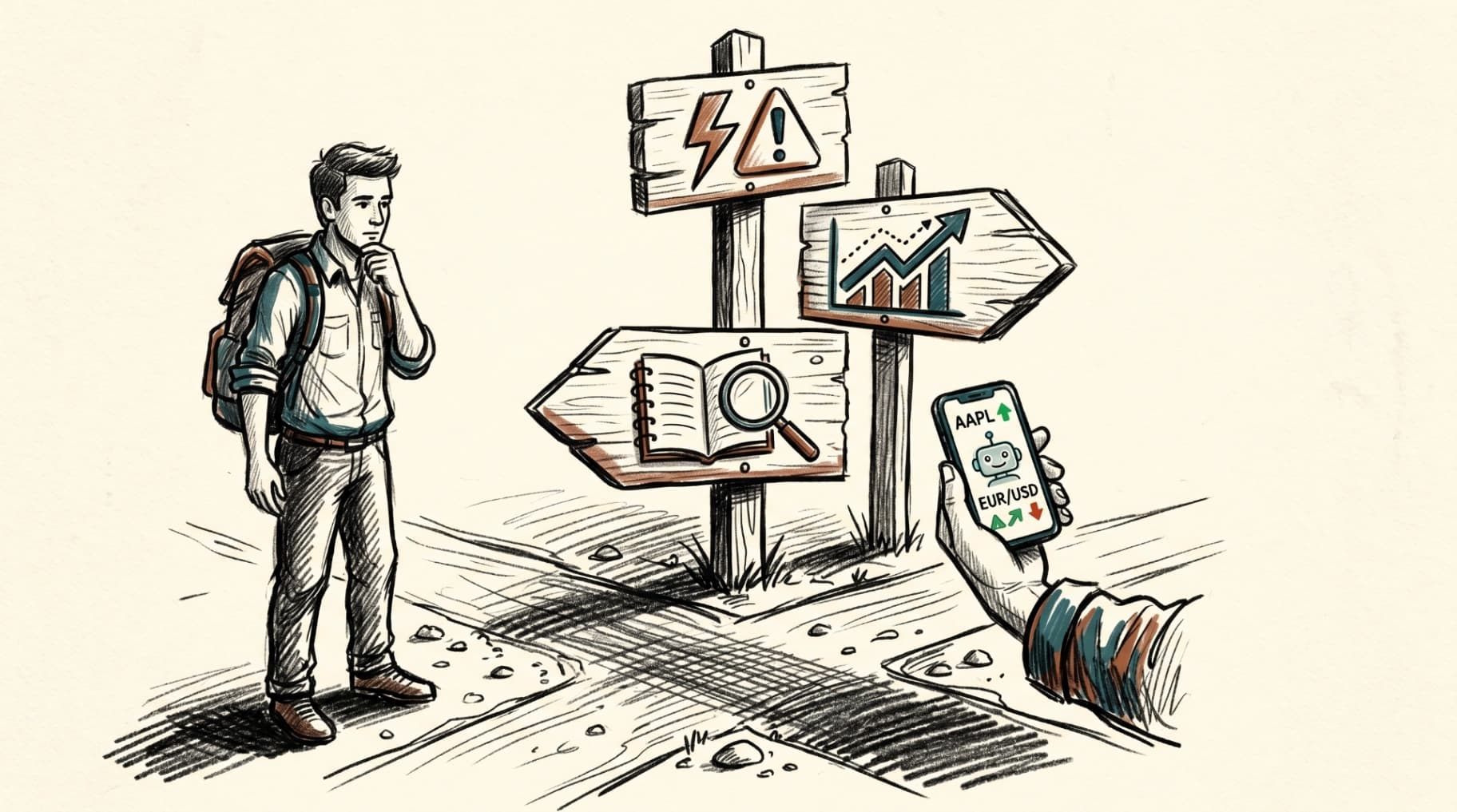
Search "AI trading software" today and you'll find products making nearly identical promises in nearly identical language. They'll spot what you're missing. They'll find your edge. They'll change the way you trade, starting now. Strip away the marketing and these tools fall into categories that have very little in common with each other, and knowing which one you're looking at matters more than any feature list.
Most traders who go searching for AI trading software are reacting to a specific feeling: a sense that there's a gap between how they think they trade and how they actually perform, and a hope that AI can close it. That instinct is correct. But "AI trading software" has become broad enough as a category that the term alone tells you almost nothing about what a tool will actually do for you.
Here's how to make sense of it.
The three things "AI trading software" usually means
Most products in this space fall into one of three buckets, even when their marketing blurs the lines between them.
The first is signal and bot software. These tools use AI models to generate buy and sell signals, or to execute trades automatically based on patterns the model has identified. This is the category most people picture when they hear "AI trading," and it's also the most heavily marketed, because the pitch of a system that finds opportunities for you is the easiest one to sell.
The second is predictive and pattern recognition software. These tools analyse charts, price action, or market data and try to identify setups, trends, or probabilities. They don't necessarily place trades for you, but they're built around the idea of forecasting what the market will do next.
The third is analytics and behavioural software. This category doesn't try to predict the market at all. Instead, it analyses your trading data, your decisions, your timing, and your patterns, and helps you understand what's actually happening in your own performance. An AI trading journal is the clearest example of this category, and it's worth reading on its own.
These three categories solve completely different problems, and conflating them is where most of the disappointment in "AI trading software" comes from.
Why the loudest category often delivers the least
Signal and bot software gets the most attention because the promise is the most direct. Let the AI find the opportunity, and you just act on it.
But this category has a structural problem that's rarely addressed in the marketing. A signal is only useful if you understand why it was generated and whether it fits your current situation. Most signal tools operate as a black box. You get an alert. You don't get the reasoning behind it, and you don't get any feedback on how that signal interacts with your own trading history, your own risk tolerance, or the mistakes you tend to repeat.

That disconnect matters because trading outcomes aren't just about the setup. They're about execution, timing, and discipline, all of which are things a generic signal can't see. A trader who takes a technically sound signal but exits early out of nerves, or sizes it differently after a string of trades, ends up with a different outcome than the signal implied, and the tool has no way of explaining why.
It's also worth knowing that automated systems generating trade recommendations or executing trades sit in a different regulatory category than software that simply helps you understand your own data. That distinction is easy to miss when everything is marketed under the same "AI trading" banner.
The category that's quietly changing how traders operate
While signal and bot tools dominate the marketing, the category making the most measurable difference for traders is the third one: AI-powered analytics and journaling.
This software doesn't try to tell you what the market will do. It tells you what you actually did, and it does that at a level of depth that manual review can't match. A trading performance tracker built on AI can break down your results by session, instrument, setup type, and time of day automatically. A behavioral trading analysis layer can flag the moments where your decisions, not your strategy, were the deciding factor.
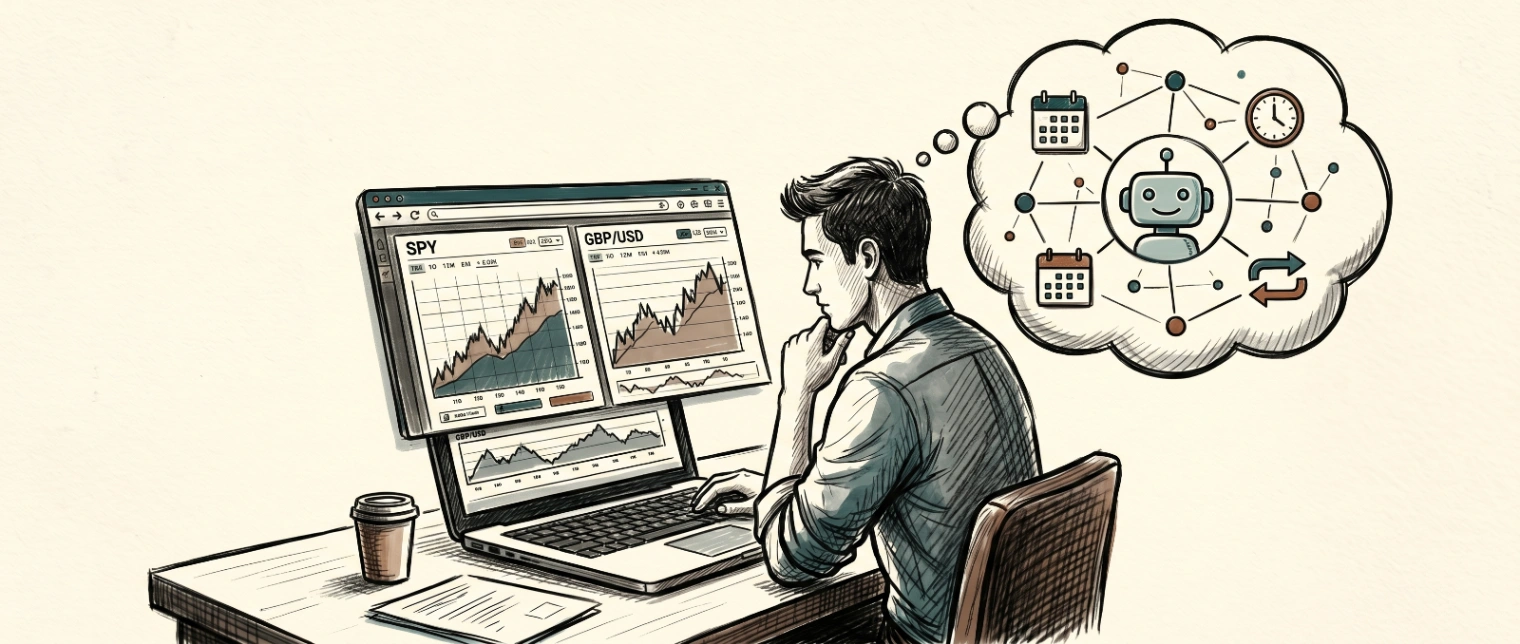
The reason this category works where signal tools often don't is that it's working with the one dataset that's actually yours: your trade history. There's no forecasting involved, no probability about what might happen next. It's pattern recognition applied to something that already happened, which means the conclusions are verifiable against your own results.
A trade analyzer in this category might show you exactly how your results shift across different setups or sessions, in a way that no signal tool would ever surface. That's the kind of insight that compounds. Every trade you log makes the picture sharper, and every session reviewed turns into better pre-trade planning for the next one.
What to actually look for before trusting the "AI" label
With the category this broad, the label "AI-powered" tells you almost nothing on its own. A few questions cut through the noise faster than any feature comparison.
Does it explain itself? Useful AI trading software shows you why it reached a conclusion, whether that's a pattern in your data or a flag on a specific trade. If a tool just outputs a result with no reasoning attached, you have no way to evaluate it or learn from it.
Is it analysing your data, or generic data? There's a meaningful difference between a tool that tells you how a market tends to behave in general, and one that tells you how you tend to behave in that same situation. The first is commentary. The second is feedback you can act on.
Does it connect to how you actually trade? AI trading software is most useful when it's reading your real broker data, not data you manually re-enter every evening. Friction is the main reason most analysis tools, AI-powered or not, get abandoned within a few weeks.
Does it avoid making outcome promises? Software that frames itself around guaranteed results or "proven" signals is making a claim it can't back up. The more useful version of AI trading software helps you see your own patterns more clearly. It doesn't promise what happens next.
The big picture
"AI trading software" isn't one thing, and the category isn't going to get less crowded any time soon. But the differences between a signal generator, a predictive scanner, and an analytics platform are differences in what problem they're actually trying to solve. Only one of those problems, understanding your own trading, is something software can solve reliably.
If you've tried an AI trading tool before and felt like nothing changed, there's a good chance it wasn't built to. The tools quietly making a difference for traders right now aren't the ones predicting the market. They're the ones reading your own data back to you in a way you've never been able to see it before.
Platforms like ChartWise sit in that third category on purpose. No signals, no predictions, no black box. Just your trades, analysed in depth, with an AI layer that helps you ask the right questions about your own performance and actually get answers.
FAQ :
What is AI trading software?
AI trading software is a broad term covering any platform that uses artificial intelligence somewhere in its workflow. This ranges from automated signal generators and predictive scanners to analytics platforms that review your trading data and behavior.Is AI trading software the same as a trading bot?
No. A trading bot is one specific type of AI trading software, one that generates or executes trades automatically. Many AI trading platforms, including analytics and journaling tools, don't place trades at all. They analyse data instead.Can AI trading software guarantee results?
No legitimate AI trading software can guarantee outcomes. Markets are uncertain, and any tool claiming guaranteed results or "proven" signals should be treated with caution regardless of how advanced its AI claims to be.What's the difference between predictive AI tools and analytics AI tools?
Predictive tools try to forecast what the market will do next, based on chart patterns or price data. Analytics tools look backward at your own trading history to identify patterns in your decisions and performance. The second category tends to produce more actionable, verifiable insights.Do I need AI trading software if I already journal manually?
Manual journaling is valuable, but AI software can analyse far more data points than a person reviewing rows can manage, and it does it consistently every time. It's less about replacing the habit and more about making the review process deeper and easier to sustain.How do I know if an AI trading tool is actually useful?
Look for tools that explain their reasoning, analyse your own trade data rather than generic market data, integrate directly with your broker, and avoid making outcome promises. If a tool can't explain why it reached a conclusion, it's harder to learn from or trust.Is AI trading software only for experienced traders?
No. Newer traders often benefit most from the behavioural feedback, since it surfaces habits before they become ingrained. Experienced traders tend to use it to refine an edge that already exists.