Most traders who journal still don't improve. That's the part nobody talks about.
They open a spreadsheet. They log their entries and exits. They write a few notes. They close the tab and do it again tomorrow. Weeks pass. Maybe months. And then at some point, they look back at everything they've written and realise they can't actually answer the only question that matters: what is making me better?
That's not a discipline problem. That's a data problem.
A spreadsheet holds your history. It doesn't read it. It doesn't notice that you consistently exit early on Fridays, that your biggest losses cluster around high-impact news events, or that your best setups share three things in common you've never consciously identified. That pattern is in there — buried in hundreds of rows — but you can't see it because you're the one doing the looking.
This is what an AI trading journal is designed to solve.
What a traditional trading journal actually does
Before understanding what makes an AI journal different, it's worth being honest about what the traditional version can and can't do.
A standard trading journal or spreadsheet is a recording tool. It captures what happened — entry price, exit price, position size, instrument, time. If you're disciplined, you add notes: your reasoning, how you felt, what you noticed. And that discipline is genuinely valuable. Traders who journal consistently tend to make fewer repeated mistakes because they've at least given themselves a record to look back at.
But the problem shows up during the review.
Reviewing a spreadsheet is manual analysis. You're scanning. You're eyeballing averages. You're drawing conclusions based on the trades you remember most vividly, which tends to be your recent ones and your worst ones — not the full picture. Human memory is biased in ways that are hard to correct for without external help.
And even traders who build out formulas, colour-coded rows, and pivot tables eventually hit the same ceiling: the tool shows you what you did, but not why the pattern exists or what it means for how you should trade next week.

What an AI trading journal actually does differently
An AI trading journal doesn't just store your trades. It reads them.
When you sync your broker data into an AI-powered platform, every trade becomes part of a dataset that gets analysed automatically — not by you scanning rows, but by a system looking for patterns across your entire history.
That analysis happens across multiple layers at once.
The first layer is performance. How did you do by instrument, by session, by setup type, by position size, by day of the week? A trading performance tracker at this level isn't just summarising your numbers. It's comparing your behaviour in different conditions and surfacing where your edge is strongest versus where it consistently breaks down.
The second layer is behavioural. This is where AI journaling separates itself from everything else. Behavioural analysis looks at how your psychology shows up in your data. It detects patterns like entering larger positions after a series of wins, exiting trades earlier than planned when a position moves into profit, or increasing frequency after a losing session. These are emotional patterns that every trader makes — and they're nearly invisible when you're reviewing manually. The data shows them clearly.
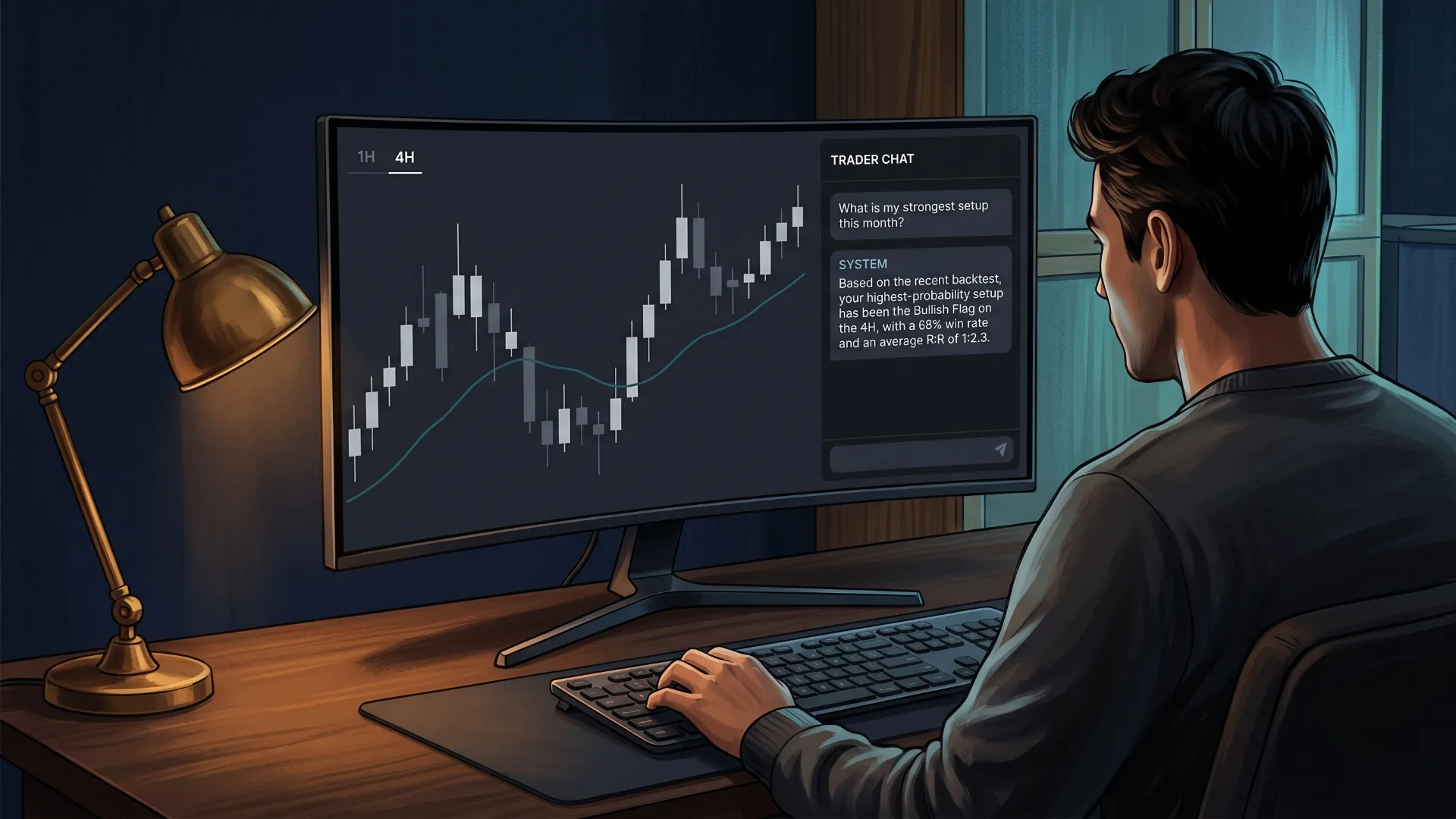
The third layer is conversational. Modern AI trading journals let you ask questions about your own trading in plain English. "Why did I struggle last month?" "What's my best setup?" "When do I trade best?" Instead of building a report, you ask. Instead of formatting a pivot table, you get an answer. That shift — from passive recording to active querying — changes how traders actually use the tool.
The behavioural layer is where most traders lose the most ground
Most of the edge traders lose isn't lost on bad setups. It's lost on good setups that were handled poorly. Exiting before the target because the trade felt uncomfortable. Skipping a valid entry because the last two trades failed. Adding size on a winner when the original plan called for none. These decisions feel intuitive in the moment. In hindsight, looking at the numbers, they're expensive and consistent habits.
Behavioural trading analysis makes those habits visible.
When a system correlates your logged emotional states with your trade outcomes over time, patterns start emerging that would take months of manual review to identify. You might discover that the trades you tag as "uncertain" entries actually perform better than your "high confidence" ones — which tells you something important about how your gut feel relates to reality. You might see that trades taken between 2 and 4pm have a noticeably different profile than your morning trades, not because the market is different, but because your decision quality shifts as the day progresses.
These aren't insights you can manufacture by trying harder. They require a large enough sample and the right analytical framework to surface — which is exactly what an AI-powered journal provides.
What changes when traders switch
The most consistent feedback from traders who move to an AI journal is not that their strategy improved overnight. It's that their self-awareness improved — and that changed everything downstream.
When you can actually see where your risk-to-reward ratio is being compromised — not in theory but in your own trade history — it becomes much harder to repeat the behaviour unconsciously. When the system surfaces a pattern and you can see it backed by your own data, you stop treating it as someone else's problem.
The second change traders notice is consistency. Not strategy consistency, but process consistency. When reviewing becomes easy — when a daily summary is automatically generated, when insights are surfaced without you having to dig — traders actually do it. The number one reason most journaling attempts fail is friction. The manual version is slow and effortful. The AI version meets you where you are.
This matters because a trade review process only compounds if it happens regularly. Five minutes of review three days a week is worth less than two minutes every single day. The tool that gets used consistently will always outperform the one that demands more discipline.

A realistic picture of what AI journaling can and can't do
An AI trading journal doesn't predict markets. It doesn't tell you what to trade tomorrow. It doesn't replace the judgement a trader develops over years of experience. What it does is help you understand what your own data is telling you — which is something most traders either don't look at deeply enough or don't have the time to analyse manually.
It also won't fix a fundamentally broken strategy overnight. If the setups themselves have no edge, the journal will show you that clearly. But a data-driven picture of what isn't working is still more useful than a vague sense that something is off.
The traders who get the most out of AI journaling are the ones who treat it as a feedback system rather than a reporting tool. You're not logging trades to create a record. You're building a dataset that teaches you about yourself over time. Every trade you add makes the picture clearer. Every question you ask makes the next one more specific.
The big picture
The gap between traders who improve and traders who stay stuck is rarely about strategy. Most traders already know enough about markets to build an edge. What they lack is a clear, honest feedback loop that shows them how they're actually trading versus how they think they're trading.
An AI trading journal closes that gap. Not by doing the trading for you, but by doing the analysis that you don't have the time, tools, or objectivity to do yourself.
Platforms like ChartWise combine automated journaling, behavioural analytics, and an AI assistant that lets you query your own trade data in plain language — so that review becomes something you actually look forward to, because it gives you something useful every time.
If you've been journaling and still feel like you're going in circles, the issue isn't that you need more discipline. It's that you need better information. And better information starts with a journal that actually reads what you've written.
FAQ
What is an AI trading journal?
An AI trading journal is a platform that automatically records your trades, analyses your performance data, and uses artificial intelligence to surface patterns in your behaviour and execution that would be difficult to identify through manual review.
How is an AI trading journal different from Excel?
Excel stores data. An AI journal analyses it. The difference is that an AI-powered platform can identify behavioural patterns, correlate your emotional states with outcomes, and answer specific questions about your trading — automatically, without you building formulas or pivot tables manually.
Do I need to be a professional trader to use an AI trading journal?
No. AI trading journals are useful at any experience level. For newer traders, the behavioural feedback helps identify bad habits early. For experienced traders, the pattern recognition helps refine an edge that already exists.
Does an AI trading journal predict trades?
No. An AI trading journal analyses your past trades and behaviour — it does not predict future market movements. Its value is in helping you understand your own patterns, not in generating trade signals.